32615
•
10-minute read



Both business owners and digital marketers have a lot on their plates. Maintaining a steady Google presence alone is enough of a task to take up most of your time. But what about tuning into what your customers have to say? In other words, how do you keep track of the conversations around your company while implementing the insights you get into your marketing efforts?
This is where social listening steps in — the process of collecting and analyzing mentions of your brand (or any keywords for that matter) on social media and the web in general, using dedicated tools.
While this might sound like an extra task on your to-do list, social media monitoring can be of massive help in all of your business activities. In fact, if there was a marketing word-of-the-decade, social media listening might be our best candidate for 2020 and further on.
Despite what the name suggests, social media listening is not only about social media. Social media monitoring tools are equipped to scrape the entire internet and deliver mentions of your company, competitors, hashtags, or any industry-related keywords in real-time.
What you can then do with the mentions is turn them into leads, run market research by collecting and analyzing qualitative data to make informed business decision, gain competitor intel, build backlinks, develop better products, engage with your audience — you name it!
Whatever the ultimate objective, social media listening benefits your business because linkless mentions are important, and they're here to stay. Put simply, as much as you care about your backlink profile, it makes total sense to cover untagged mentions, aka “implied links”.
Best part? It's fully automated! Social listening software fetches real-time data and performs powerful analytics while you keep fighting the good fight on Google and beyond.
Are you intrigued? Let's take a closer look at the top social listening tools to try now.
Non-stop monitoring and actionable insights.
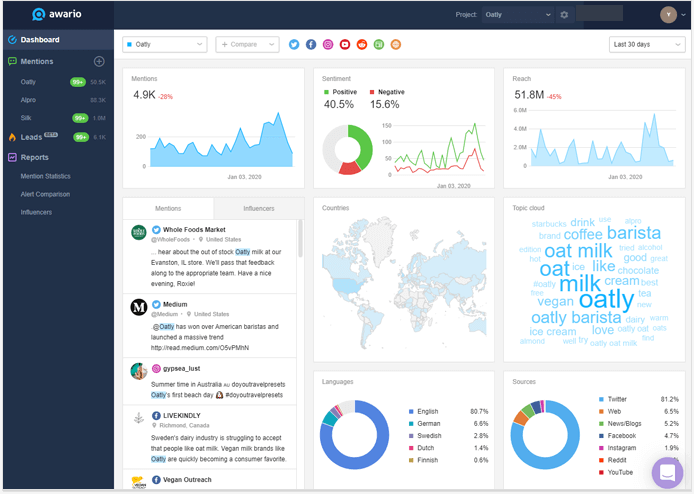
Awario is one of the best social media monitoring tools for anyone looking for Enterprise-level capabilities at an affordable price. Depending on the size of your business, you can pick a plan corresponding to your resources and needs, starting at $29/mo.
Any platform, location, or language — you set the parameters, and Awario starts tracking to fetch every single mention of your company, product or service regardless of the scope. Use Boolean search to create complex queries and run spot-on monitoring. That includes Reddit monitoring, so you’ll never miss valuable conversations in one of the web’s most active communities.
For advanced insights, turn to the sentiment analysis dashboard and assess the reputation of your brand or any competitors'. Monitor individual social media campaigns or keep your finger on the average brand pulse — either way, Awario will deliver influencers, link prospects and leads for you to engage with.
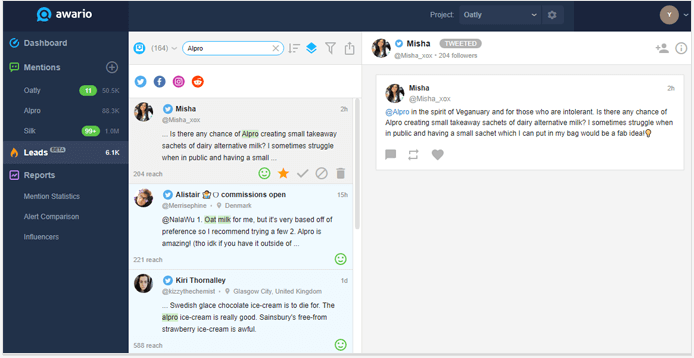
Supported platforms: Twitter, Facebook, Instagram, YouTube, Reddit, news, blogs, forums, review platforms, and the web as such.
Pricing: the Starter plan is $29/mo (3 topics to monitor and 30,000 new mentions to be fetched), Pro is $89/mo (15 topics and 150,000 new mentions), and Enterprise is $299/mo (50 topics and 500,000 new mentions). An annual plan saves you 2-months' expenses.
Free trial: 7 days for the Starter plan.
Advanced brand management and analytics.
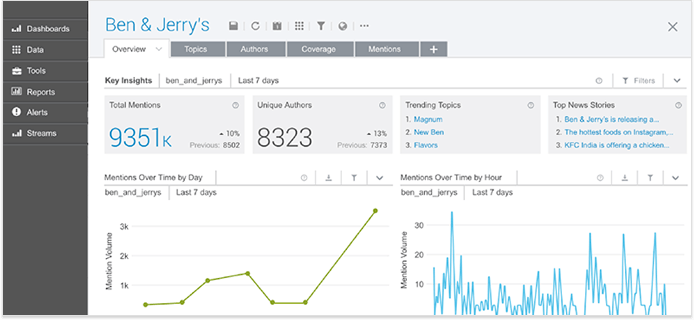
Brandwatch is an Enterprise-level tool with analytics covering everything from customer demographics to image recognition for tracing your logo across the web.
A powerful social media monitoring tool, Brandwatch offers daily segmentation of the conversations around your products or services. With a clear understanding of the sentiment and intent your audience is displaying at any given time, you can visualize this data for easy distribution across your company's departments.
Brandwatch helps you discover topics and trends your customers engage best with, as well as measure your overall content performance. As part of your content monitoring and refinery efforts, take note of the influencers identified by the tool for more precise targeting.
Supported platforms: Twitter, Facebook, Instagram, Reddit, Tumblr, blogs, forums, news, review sites, and video sites.
Pricing: an Enterprise-level tool, Brandwatch offers 2 types of plans. Pro (10,000 mentions) is $800/mo. Custom plans of the Enterprise level are available upon request.
Free trial: no.
Social data analytics for multinational brands.
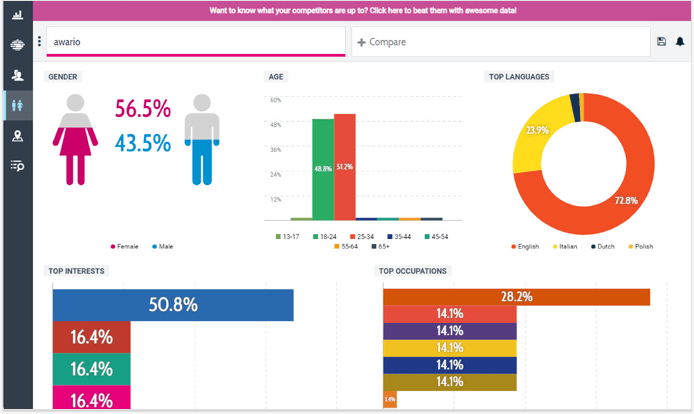
Talkwalker is another Enterprise-level social media tool with impressive social listening features. In addition to social media monitoring, it covers print, broadcast, and TV outlets to measure your traffic and brand impact across audiences and locations.
Translate your marketing efforts into KPIs and use customizable dashboards for sharing your findings with colleagues. With in-depth sentiment analysis and reputation scores, you'll be able to check on your campaign performance globally. You can then use these insights to develop targeted messages and boost audience engagement.
To help you navigate the influencer network for your niche, Talkwalker offers its own Virality Map. See what topics go vital and engage with the key figures on social media to give momentum to your messaging and marketing campaigns.
Supported platforms: Facebook, Twitter, LinkedIn, YouTube, Instagram.
Pricing: the Basic (10,000 monthly results) plan comes at $9,600/year, Corporate and Enterprise plans (100,000 all the way to 1 Million+ monthly results) are available upon request.
Free trial: no.
Social media management and in-depth competition analysis.
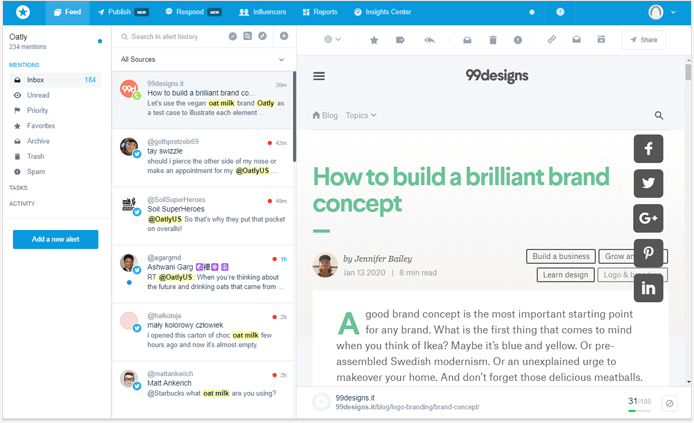
Mention is a social media monitoring tool that fetches conversations around your company, products or any keywords relevant to your industry, alongside metrics such as volume, influence score, sentiment, etc.
Mention lets you spot trends, get in touch with influencers and the media, and engage in online conversations important to your business. Run a thorough competition analysis by tracking your competitors and gain insights into their share of voice, content strategies, and ongoing marketing activities on any given platform.
Once you have a clear picture of your competitive landscape, go ahead and start re-shaping your online presence right from the app. Use Mention to preview, schedule and post content that is engaging and useful. The tool's content planning feature makes monitoring and curating social media delay-free and efficient.
Supported platforms: Twitter, Facebook, Instagram, YouTube, review sites, blogs, forums, and the web.
Pricing: the Solo plan comes at $29/mo (2 topics to track and 3,000 mentions to be collected), Pro is $99/mo (5 topics and 5,000 mentions), and Enterprise is $450+/mo (10+ topics and 100,000 mentions). All yearly plans save you 2 months of expenses.
Free trial: 14 days for Solo and Pro. The Free plan is also available and lets you track 1 topic and collect 250 mentions.
Effortless message management for large teams.
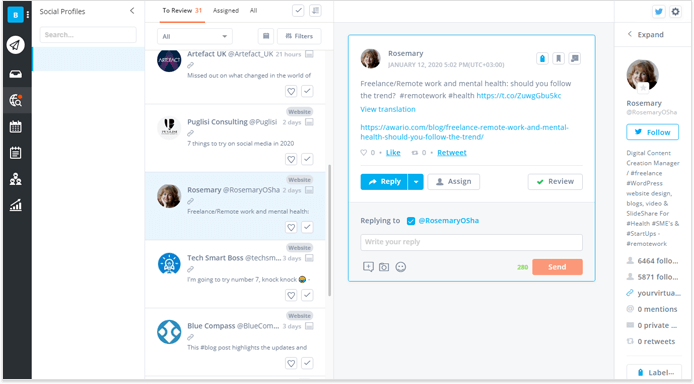
Agorapulse is a social media management software that offers social listening functionality and makes collaboration easy. The tool is brilliant for SEO agencies and large teams managing multiple social media accounts.
Agorapulse offers a one-inbox approach to social media monitoring and management of all accounts your team is handling. It lets you assign roles and delegate tasks right from the tool: reply, review, assign, schedule, queue, and publish social media posts, including Instagram carousels and Stories.
Unified content and publishing calendar, bulk upload via CSV, recurring scheduling of evergreen content and team collaboration are all brilliant features that make teamwork as smooth as it gets. Naturally, Agorapulse also keeps you updated on the trends, hashtags, influencers, and any buzz your customers generate.
Supported platforms: Facebook, Twitter, Instagram, LinkedIn, YouTube.
Pricing: Medium (10 social profiles, 2 users) comes at €99/mo, Large (25 social profiles, 4 users) is €199/mo, X-Large (40 social profiles, 8 users) is €299/mo, and Enterprise (60 social profiles, 20 users) is €499/mo. Yearly plans save you up to 20%.
Free trial: 15 days for all plans.
Hashtags analytics and AI-driven market research.
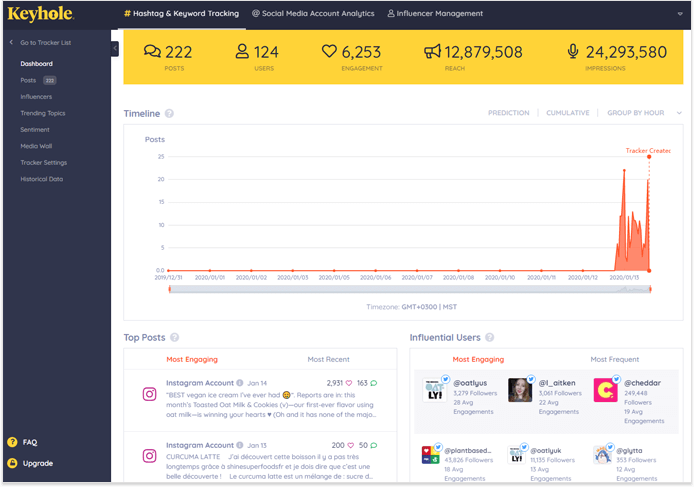
Keyhole is an analytics and social monitoring tool that offers both real-time tracking and historical data. Whether it's campaign monitoring or brand optimization you're after, the tool runs advanced market research and helps you make better informed product decisions.
Use Keyhole to get AI-predicted trends, anticipated performance, engagement, as well as reach and impressions in the next 24 hours, 7 days or 30 days. The tool relies on machine learning to run market research and deliver best keywords ramping up right now.
Similar to other social media monitoring tools, Keyhole lets you collect and respond to mentions of your company, therefore building better customer support, gaining product insights, engaging with influencers and generating leads.
Supported platforms: Twitter, Instagram, Facebook, YouTube, news, blogs, forums.
Pricing: Keyhole offers 3 monthly plans depending on your company size. Professionals (3 trackers and 20,000 posts) comes at $199/mo, Corporations (10 trackers and 150,000 posts) is $599/mo, and Agencies & Enterprise (custom trackers and posts) is $999+/mo. Yearly plans save you up to 50%.
Free trial: 7 days for Professionals and Corporations.
Social media collaboration and audience insights.
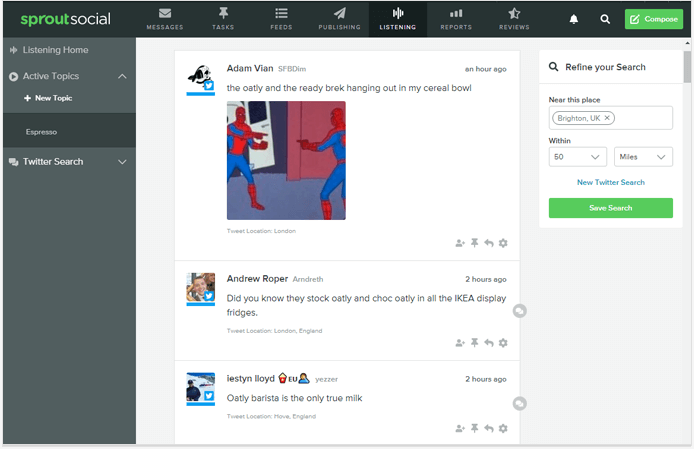
Sprout Social is one of the top social media monitoring tools with a focus on social listening, publishing, analytics, and team collaboration. The tool lets you track real-time results of your ongoing campaigns, get to know your customers and learn from your competitors.
Sprout Social is great for agencies and marketing teams, with team inbox management, activity tracking, and workflow efficiency assessment features. Schedule social media work for multiple clients and assign tasks across teams in-app or via email; for more insights into collaboration effectiveness, you can always refer to the Team Report.
Empower your staff to share brand content across their social media: Sprout Social gives you the platform and tools to foster and monitor employee advocacy and social selling, enhancing your reach and generating more leads.
Supported platforms: Facebook, Twitter, Instagram, LinkedIn, Pinterest.
Pricing: Standard (5 social profiles) comes at $99 per user/mo, Professional (10 social profiles) is $149 per user/mo, and Advanced (10 social profiles) is $249 per user/mo.
Free trial: 30 days for all plans.
Content discovery and link building.
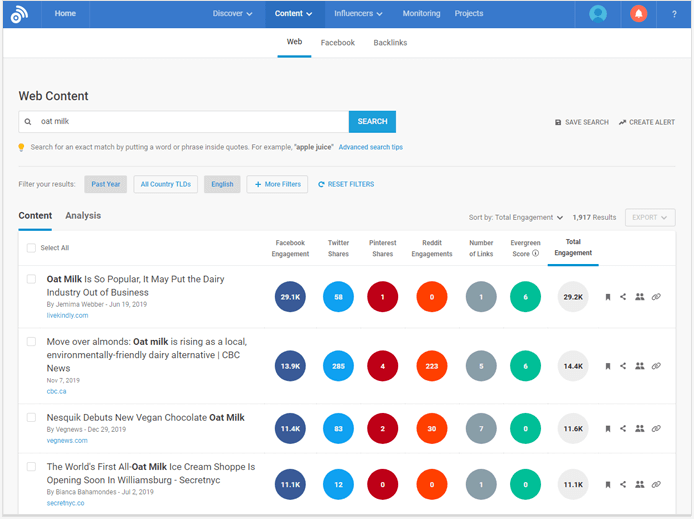
BuzzSumo is your go-to option among social media monitoring tools for content research, digital PR, and competitor intelligence. The tool offers backlink profile audit features, displaying the most recent and most shared backlinks for any URL or domain.
Discover popular questions, trends, and industry-related stories from key blogs, influencers, publishers and the media. By keeping an eye on the biggest names, you'll be able to engage with their content and amplify your traffic.
In addition to monitoring your company's mentions on social media which you can then turn into backlinks, BuzzSumo notifies you of every new backlink spotted. By getting in touch with the linking domains you can identify more backlink opportunities, building a stronger backlink profile as a result.
Supported platforms: Facebook, Twitter, Instagram, Pinterest, and Reddit.
Pricing: the Pro plan (5 alerts and 5,000 mentions) comes at $99/mo, Plus (10 alerts, 10,000 mentions) is $179/mo, Large (30 alerts and 20,000 mentions) is $299/mo, and Enterprise (50+ alerts) is $499+/mo. All yearly plans save you 20%.
Free trial: 7 days for Pro, Plus, and Large.
Easy management of multiple Twitter accounts.
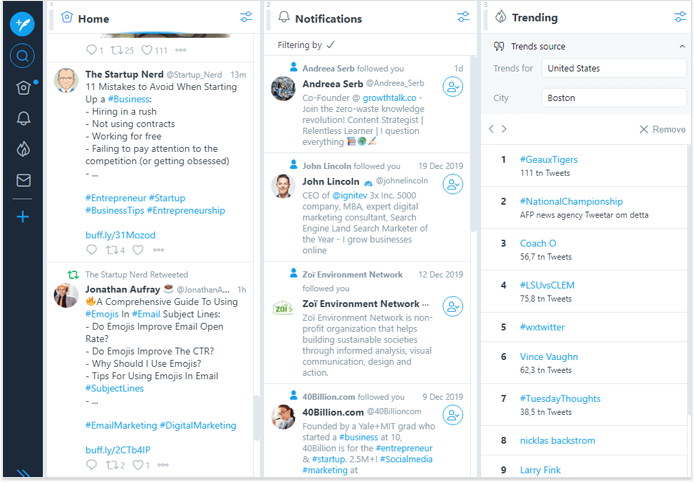
TweetDeck is a social media monitoring tool and dashboard for Twitter that allows you to combine your accounts into one timeline or use separate columns for each, as well as schedule and post tweets, build tweet collections, and track mentions of your brand, topic or any trend.
Once you have all your social media accounts in one timeline, you can set a default account or use TweetDeck to post, link and follow from multiple accounts. You can also break the timeline into columns depending on the types of content you're interested in, including mentions or recent tweets on a particular trend.
The app lets you apply column filters to sort out content, location, users, engagements, and alerts. By doing so, you'll be able to monitor keywords, hashtags, geotagged tweets, or tweets with maximum engagement.
Supported platforms: Twitter.
Pricing: the tool is free.
360° social media solution for growing businesses.
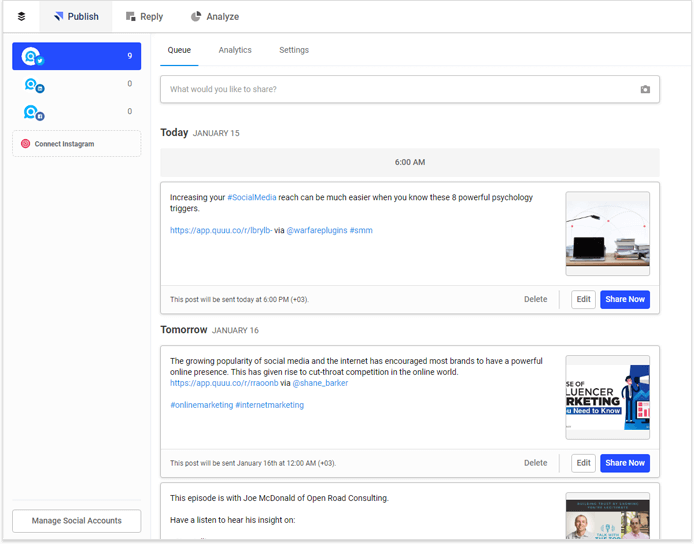
Buffer is a single dashboard solution for monitoring multiple social networks as a team. With all your social accounts combined under one umbrella, social media management can be easily coordinated and planned ahead.
Buffer enables you to plan, draft, and schedule your social media posts, as well as review and approve your teammates' submissions — all to make sure you perfect your publishing workflow and focus on perfecting your content and messaging across platforms.
Once you have your social media workflow set up, refer to the analytics dashboard for insights into individual accounts' performance. For more user feedback and customer support intel, use the shared team inbox features and tune into conversations around your company.
Supported platforms: Twitter, Instagram, Facebook, LinkedIn, Pinterest.
Pricing: the Pro plan (8 social accounts, 100 scheduled posts, and 1 user) comes at $15/mo, Premium (8 accounts, 2,000 posts, 2 users) is $65/mo, and Business (25 social accounts, 2,000 posts, 6 users) is $99/mo. All yearly plans save you up to 20%.
Free trial: 7 days for the Pro plan, 14 days for Premium and Business.
Complete media monitoring suite.
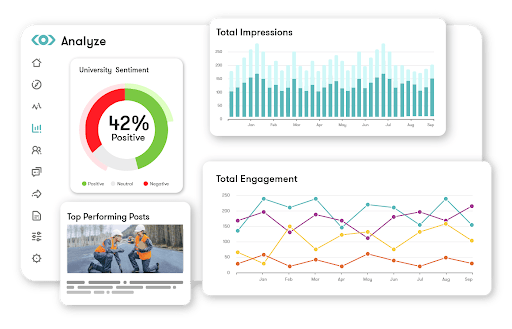
Meltwater is a cutting-edge social listening tool that empowers businesses to monitor and analyze online conversations across a wide array of social media platforms, news sites, blogs, and forums. By leveraging its powerful algorithms, Meltwater captures and processes vast amounts of data in real-time, tracking specific keywords, hashtags, and user mentions relevant to a brand or industry. This enables organizations to gain deep insights into brand perception, customer sentiment, and emerging market trends.
One of Meltwater's key strengths is its ability to provide detailed analytics and visualizations. Users can access dashboards that display metrics such as engagement rates, sentiment analysis, share of voice, and influencer impact. These insights help businesses understand how their brand is perceived in the digital landscape, identify opportunities for engagement, and measure the effectiveness of their social media strategies.
Supported platforms: Facebook, Instagram, X, YouTube, Reddit, LinkedIn, Twitch, Pinterest, blogs, discussion forums, podcasts, online news, consumer review sites.
Pricing: Pricing is custom.
Free trial: No.
Social media listening is as versatile as it is rewarding. With so many use cases — from market research to link building and sales — it proves to be the most time- and cost-efficient way to make sense of the billions of conversations happening on social media daily.
Fact is, companies of any size can benefit from putting effort into as much social listening as their resources allow. The variety of social listening tools currently on the market lets you make smart investments and reap the most benefit at the least possible cost — or no cost at all.

By: Julia Miashkova
 Article stats:
| Linking websites | N/A |
| Backlinks | N/A |
| InLink Rank | N/A |