5622
•
12-minute read

For years, SEO was a game of rankings. Position one meant traffic. Position three meant opportunity. But in 2026, that mental model is officially broken.
Today, users don’t search first — they ask. And AI systems answer before anyone scrolls, clicks, or compares. Google AI Overviews, AI Mode, ChatGPT, and other AI-first discovery tools now sit between your content and your audience. If your content isn’t selected, summarized, or cited by these systems, it may as well not exist.
That’s where AI content optimization comes in.
This isn’t about gaming algorithms or stuffing content with keywords. It’s about structuring information in a way AI systems can retrieve, trust, and reuse — while still being genuinely useful for humans.
In this playbook, you’ll learn how AI search actually works, what makes content “citable,” and how to optimize your site for visibility in AI Overviews and beyond. Whether you’re an SMB trying to protect organic traffic, an SEO pro adapting to AI-first SERPs, or a content marketer planning for the next wave, this guide will show you how to stay visible where decisions now happen.
Arthur Andreyev is the CMO and a seasoned content strategist with a passion for making SEO practical and results-driven. He blends over a decade of marketing expertise with a deep understanding of search algorithms to craft strategies that help businesses stand out in competitive markets. At SEO PowerSuite, Arthur leads the marketing vision, drives content strategy, and shares actionable insights on ranking higher, faster. Outside of work, he’s an avid traveler and coffee enthusiast, always on the hunt for the next great brew.
AI content optimization is the practice of designing, structuring, and maintaining content so it can be understood, retrieved, and cited by AI-powered search and answer systems — not just ranked by traditional search engines.
Traditional SEO focused heavily on signals like backlinks, keyword placement, and technical hygiene. While those still matter, AI-driven discovery layers add an entirely new filter. Large language models don’t “browse” the web the way humans do. They retrieve information, evaluate its credibility, and synthesize answers from sources they trust.
That means your content must succeed at three levels:
AI content optimization bridges the gap between search intent and AI interpretation. It’s not about writing for machines — it’s about removing friction so machines can confidently surface your content to humans.
Another key difference: visibility no longer requires a click. In AI Overviews, your brand may appear as a citation, a summarized source, or an implied authority. Users might never land on your page, yet your content still shapes decisions, brand perception, and downstream conversions.
In short, AI content optimization shifts the goal from “ranking higher” to becoming the trusted reference AI systems rely on. And in 2026, that distinction separates content that survives from content that quietly disappears.
AI didn’t just change how people search — it changed what search means. In 2026, discovery is no longer a list of options. It’s a curated answer, assembled in real time, often before a user ever sees a traditional SERP. Understanding this shift is essential if you want your content to stay visible, cited, and trusted.
AI-first discovery became mainstream for one simple reason: it’s faster and cognitively easier. Users no longer want to compare ten blue links when an AI system can synthesize the best answer in seconds.
Google AI Overviews, AI Mode, ChatGPT, Perplexity, and Microsoft Copilot all operate on the same underlying principle: reduce friction between question and clarity. Instead of searching multiple pages, users now expect:
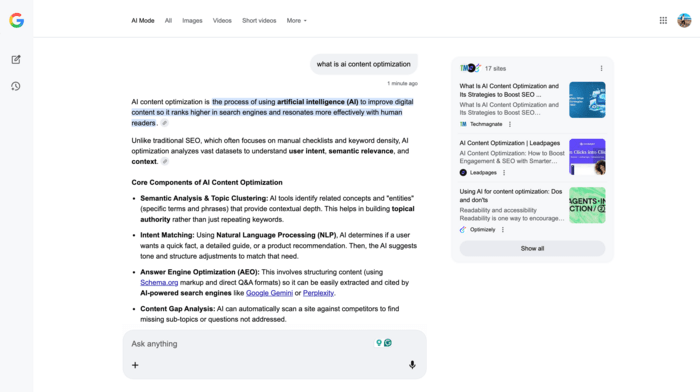
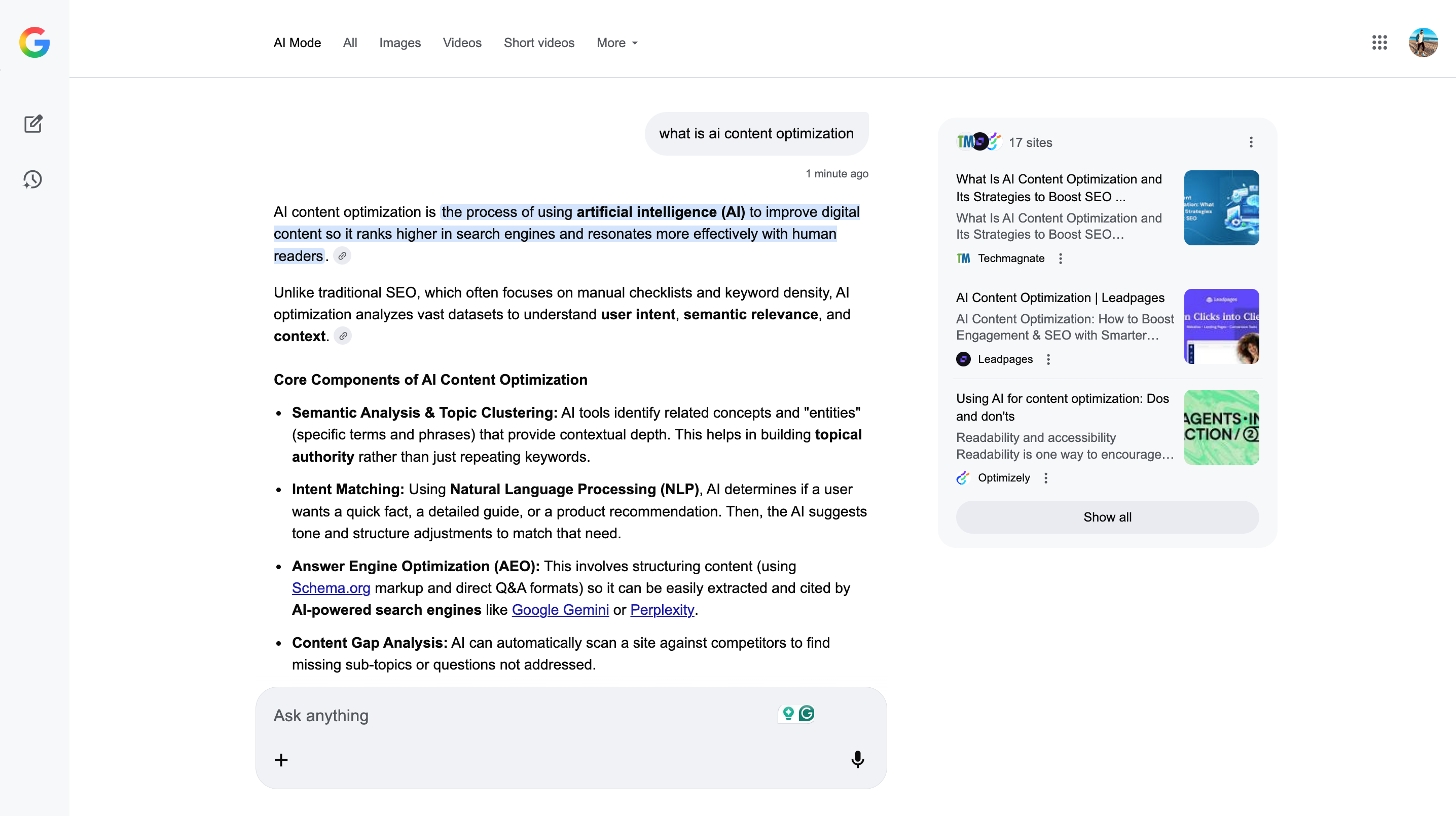
This means organic visibility now happens inside the answer itself. Being “good enough to rank” is no longer sufficient. Content must be good enough to replace ten other pages in a single response.
A critical shift in 2026 is that AI systems heavily favor:
This is why many sites with strong historical rankings are seeing declining traffic — while smaller, highly focused publishers are being cited more often. AI-first discovery rewards clarity, coverage, and credibility, not domain size alone.
Early AI Overviews were experimental and inconsistent. In 2026, they are far more selective — and far more opinionated.
Two major changes matter most:
1. Source consolidation
Google now pulls from fewer sources per answer. Instead of citing ten domains, it may rely on two or three it considers highly authoritative for that topic. This raises the bar but also increases the payoff. Being selected once can mean repeated visibility across variations of the same query.
2. Trust-weighted retrieval
Google’s AI doesn’t just ask, “Does this page mention the keyword?” It evaluates:
In practice, this means shallow content is filtered out before it’s ever considered. Pages without clear authorship, vague claims, or outdated data rarely make it into AI-generated answers — even if they technically rank.
For content marketers, this marks a shift from algorithm optimization to evaluator optimization — where the evaluator is an AI model trained to mimic human judgment at scale.
The classic funnel — search, click, browse, convert — is gone. In its place is a compressed, AI-mediated journey:
Answer → Verify → Act
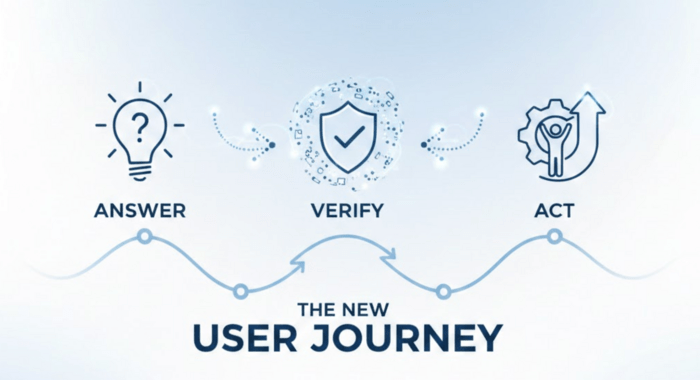

Your content’s role in this journey is often invisible but powerful. Even without a click, being cited:
This is why AI content optimization focuses on being reference-worthy, not just click-worthy. When your content consistently appears in the “verify” stage, you become part of the user’s mental shortlist — even if analytics don’t show a visit.
In 2026, the winners are the brands that understand this subtle shift: visibility isn’t measured only by traffic, but by influence inside AI answers.
AI systems don’t “read” the web the way humans do. They retrieve, evaluate, and assemble information from a limited pool of sources they consider reliable enough to quote. If your content isn’t designed for this process, it won’t be cited — even if it ranks.
Understanding how AI search chooses what to cite is the difference between being visible in AI Overviews and being silently ignored.
Most modern AI search experiences rely on Retrieval-Augmented Generation (RAG). In simple terms, the AI:
This means your page isn’t evaluated as a whole — it’s evaluated in chunks.
AI systems look for content that is:
That’s what makes content snippable. Lists, short explanatory paragraphs, definitions, comparisons, and step-by-step sections perform especially well because they can be lifted into an AI answer with minimal rewriting.
Google’s internal evaluation systems (often summarized through frameworks like AGREE — accuracy, grounding, relevance, expertise, and evidence) reinforce this behavior. Pages that mix opinions, vague claims, or fluffy introductions without clear answers are far less likely to be retrieved.
Most articles treat AI optimization like a checklist: add schema, update content, track rankings, done. That approach doesn’t work anymore — and in many cases, it actively fails.
AI visibility is systemic, not tactical. AI models don’t evaluate individual optimizations in isolation. They form an overall judgment about whether your content, your site, and your brand are worth trusting as a source. The eight steps in this section are designed to work together to build that judgment over time.
Think of AI content optimization as stacking credibility layers:
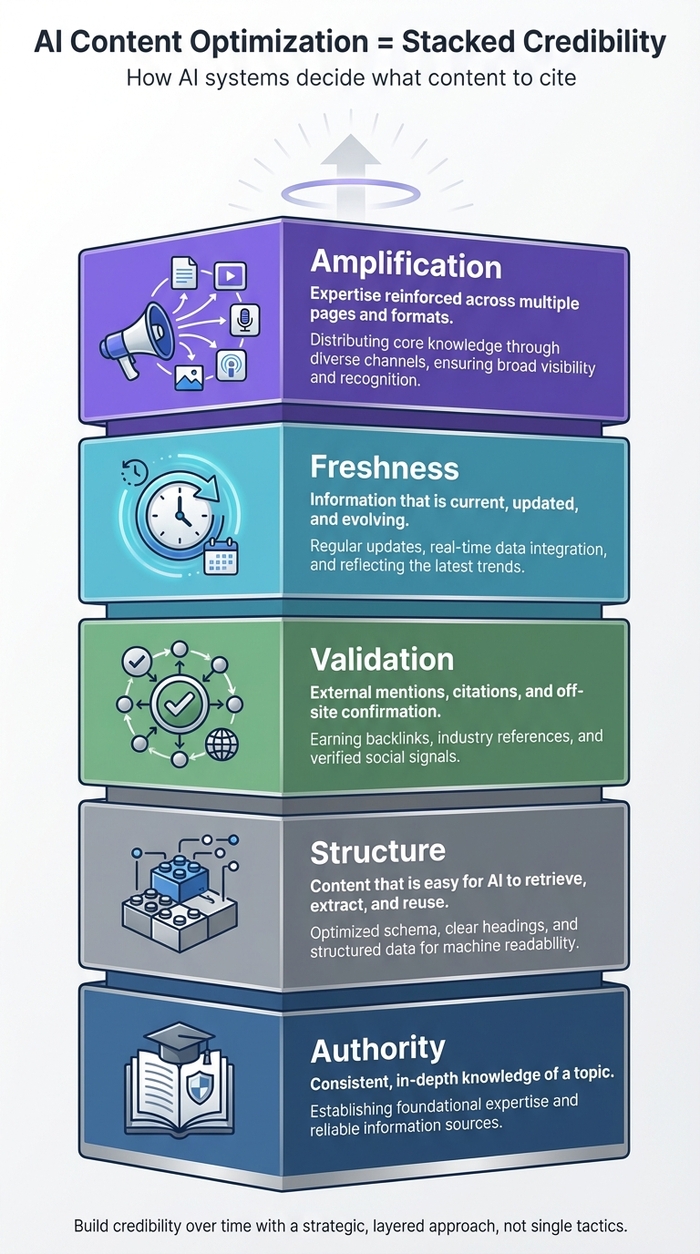
If any one of these layers is missing, AI systems may still retrieve your content — but they are far less likely to cite it, reuse it, or prioritize it over competitors.
Another critical shift in 2026 is that optimization is no longer page-by-page. AI models evaluate patterns across your entire content ecosystem. A single well-optimized article won’t outweigh a site that consistently demonstrates depth, clarity, and trust across dozens of related pages.
In the next section, we’ll start with the foundation: how to build undeniable topical authority in your niche — one of the strongest signals AI systems rely on when choosing what to cite.
If there is one signal that outweighs almost everything else in AI content optimization, it’s topical authority.
AI systems don’t ask, “Is this page optimized?” They ask, “Is this source consistently knowledgeable about this topic?”
Topical authority is how AI models decide who gets cited when multiple pages technically answer the same question.
From an AI perspective, topical authority is pattern recognition. Models look for signals such as:
If your site publishes one AI article, one SEO article, one marketing article, and one random trend piece, you’re a generalist. AI systems rarely cite generalists.
If your site publishes clusters of interconnected content around a single theme — definitions, frameworks, comparisons, use cases, updates, and best practices — you become a topical source.
That difference alone can determine whether your content is retrieved at all.
Topical authority isn’t built by volume. It’s built by intentional coverage.
Start by defining your core topic. For this guide, that might be:
Then expand outward into supporting subtopics:
Each subtopic deserves its own dedicated content — not a paragraph buried in a mega-post. AI systems prefer clear topical boundaries, not overstuffed pages trying to rank for everything.
Internal linking is critical here. Pages should naturally reference one another, reinforcing to AI systems that: “These articles belong together. They are part of a coherent knowledge set.”
When teams try to build topical authority, the bottleneck is rarely writing speed. It’s decision quality.
Most teams get stuck on questions like:
Without clear answers, content planning turns into guesswork. Pages get added, but authority doesn’t compound.
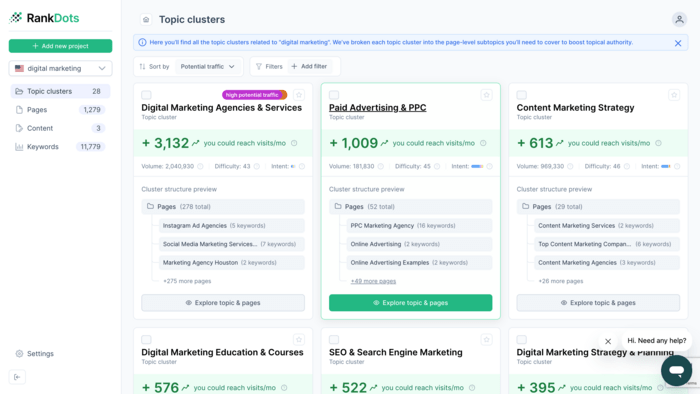
A practical way to break this loop is to stop thinking in individual keywords and instead look at how topics naturally form around user intent and search behavior. That’s the point where tools like RankDots become useful — not as a content generator, but as a way to reduce uncertainty.
By grouping related queries into coherent topic clusters and showing how they connect, RankDots helps teams see whether their content actually supports a topic or just touches it superficially. This makes it easier to spot real gaps: missing subtopics, underdeveloped angles, or pages that should exist but don’t.
Most content today is written to be read. AI-visible content must also be extracted, segmented, and reassembled.
That distinction explains why so many well-written, well-ranked articles never appear in AI answers. They communicate ideas clearly to humans, but they fail to present information in a way AI systems can reliably lift, verify, and cite.
In 2026, AI search doesn’t “read” your article top to bottom. It scans for self-contained, high-confidence sections that can stand on their own inside a generated response. If your content can’t be broken apart cleanly, it’s unlikely to be used at all.
AI retrieval systems work at the chunk level. A single H2 or even an H3 can be selected, quoted, or summarized independently of the rest of the page. That means every major section should answer a question fully enough to be cited alone.
A useful mental test is this:
If this subsection were shown without the rest of the article, would it still make sense?
If the answer is no, the section is probably too dependent on context — which is fine for humans, but risky for AI.
This is why vague headings like “Overview,” “More Details,” or “Key Considerations” perform poorly in AI retrieval. They don’t describe a discrete informational unit. Descriptive, question-oriented headings do.

"Most teams fail at AI optimization because they're still thinking in keywords. The shift to knowledge structures only clicks when you see real examples — what AI actually pulled from your niche versus what it ignored. That's why effective AI training starts with live audits, not theory."
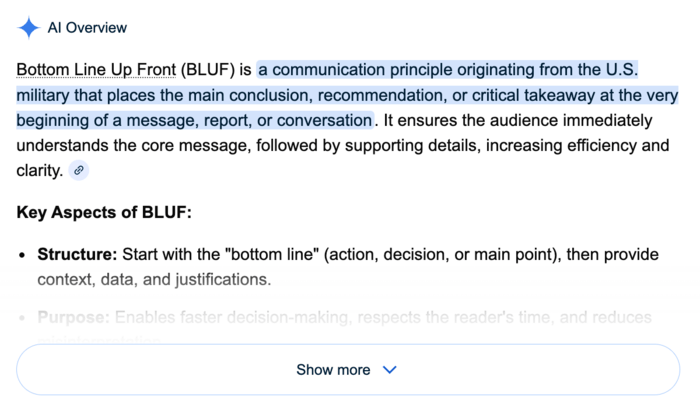
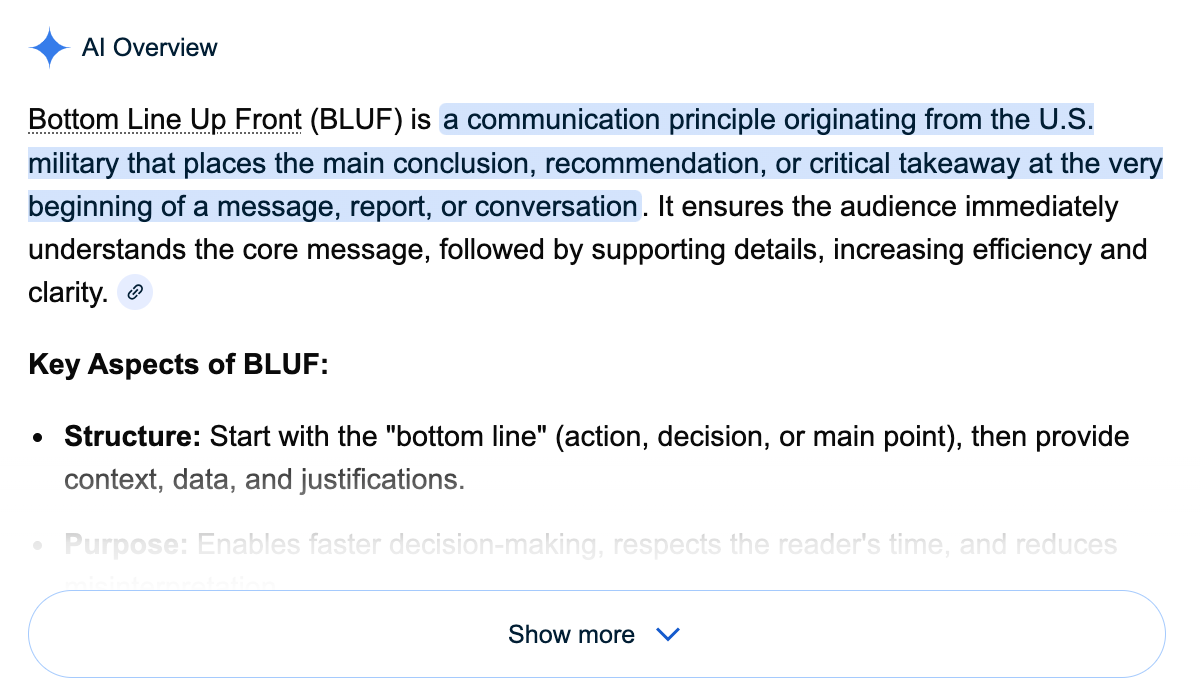
BLUF (Bottom Line Up Front) is one of the most reliable patterns for AI extraction.
AI systems prefer content where the core answer appears early, followed by explanation, nuance, or examples. This mirrors how AI answers are generated: concise conclusion first, justification second.
This doesn’t make content boring. It makes it citable.
Humans still read the rest. AI systems often don’t.
Another subtle shift in AI-era writing is paragraph discipline.
Long, winding paragraphs that mix multiple ideas are difficult to extract cleanly. AI systems prefer paragraphs that:
You’re not dumbing content down — you’re reducing ambiguity, which directly improves citation confidence.
This is also where conversational tone helps. Plain language tends to be more explicit, and explicit language is easier to ground.
Here’s a pattern AI systems reward but few writers consciously use: semantic redundancy without repetition.
When key ideas appear consistently across headings, opening sentences, and explanations — phrased slightly differently — AI systems gain confidence that the information is central, not incidental.
This is one reason AI often cites “boring” but clear content over clever writing. Clarity compounds.
AI systems don’t decide what to trust by looking at your website alone. They validate what you say by comparing it against how the rest of the web talks about you.
This is one of the least understood shifts in AI content optimization. Traditional SEO trained us to think in terms of backlinks. AI systems think in terms of reputation signals — and many of those signals never show up in link reports.
Mentions, references, discussions, and citations across the web all contribute to whether an AI model views your brand or content as reliable enough to quote.
Links are still useful, but they’re blunt instruments. AI systems care less about how a reference is linked and more about what is being said, how often, and in what context.
An unlinked mention of your brand in:
can reinforce entity trust just as effectively as a traditional backlink — sometimes more so.
From an AI perspective, repeated mentions across independent sources signal that:
“This entity exists, is recognized, and is part of the broader conversation.”
That signal is extremely valuable when AI systems decide which sources to cite in generated answers.
Most brands assume that if they’re publishing good content, trust will follow. In practice, AI systems can just as easily pick up:
If those signals go unchecked, they can quietly undermine your AI visibility — even if your on-site content is strong.
This is especially risky for small businesses, where a few external mentions can disproportionately shape how an AI model understands your brand.
Once you accept that off-site mentions influence AI trust, the practical problem becomes obvious: most teams don’t actually know what’s being said about them outside their own site.
Mentions are scattered across reviews, communities, blog posts, comparison pages, and social discussions. Many are unlinked, many are indirect, and most never show up in traditional SEO tools. Without visibility into those conversations, you’re effectively blind to a part of the trust signal AI systems rely on.
This is where a monitoring tool like Awario becomes useful — not as a branding dashboard, but as a way to surface information you otherwise wouldn’t see. It allows teams to track when their brand, products, or key pages are referenced across the web and, more importantly, to understand the context of those references.
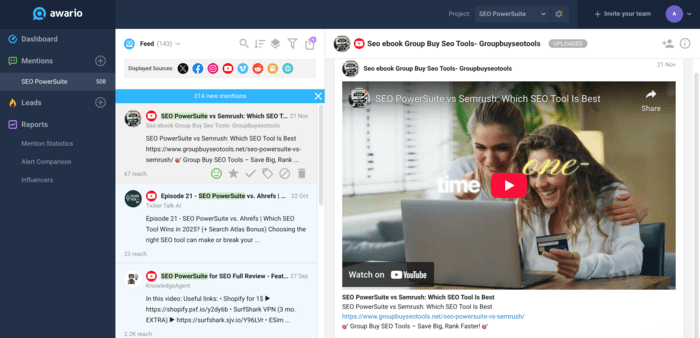
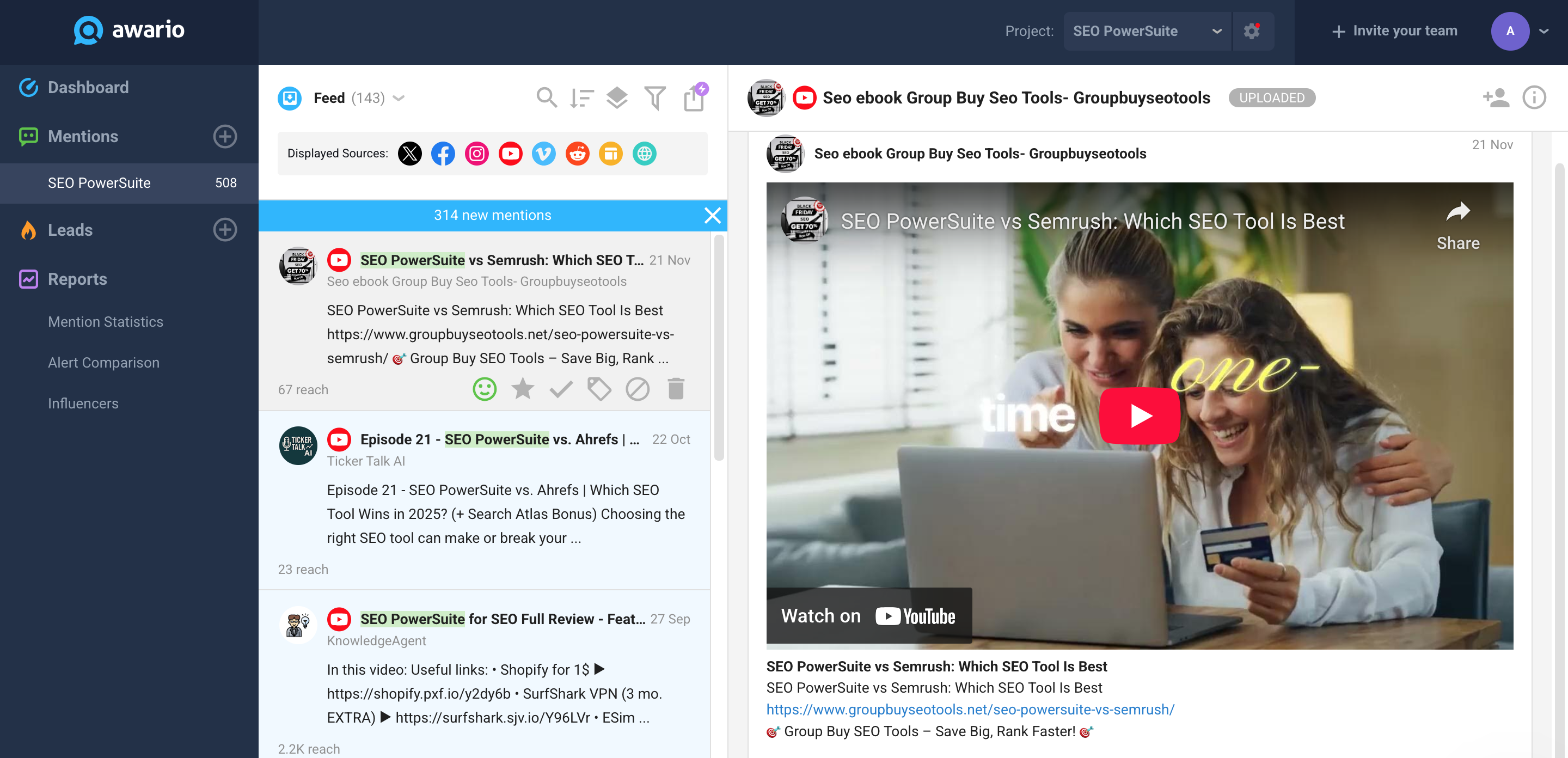
That context is what makes the difference. You can see whether external mentions reinforce the expertise you’re trying to build, oversimplify it, misrepresent it, or leave important details out. With that awareness, you can respond deliberately — by clarifying, updating content, or reinforcing the same entities and terminology on your own site.
The value isn’t in reacting to every mention. It’s in avoiding silent drift between how you describe your expertise and how the web describes it. Over time, keeping those narratives aligned reduces friction for AI systems deciding whether your content is safe to cite.
Monitoring alone isn’t enough. The real value comes from closing the loop.
When you identify relevant mentions, you can:
Over time, this creates a reinforcing cycle: your content informs the web, the web reflects your expertise, and AI systems see consistency across both.
Off-page trust signals compound quietly. You won’t always see immediate traffic spikes, but you’ll notice something else: your content starts appearing more frequently in AI answers — sometimes for queries you never explicitly targeted.
That’s the result of entity-level trust, and it’s one of the hardest advantages for competitors to replicate quickly.
One of the quiet advantages AI systems have over human readers is that they are very good at noticing what’s missing.
A human might read an article and think, “This is helpful.” An AI system reads the same article and thinks, “This answers 70% of the question — where is the rest?”
That gap is often the difference between being retrieved and being cited.
AI models don’t evaluate completeness emotionally or subjectively. They compare your content against a learned representation of what a complete answer usually contains.
If competing sources consistently explain a concept you only mention in passing — or skip entirely — your page looks incomplete, even if what you wrote is accurate.
These gaps usually show up as:
To a human, these feel like minor omissions. To an AI system deciding whether it can rely on your content, they are red flags.
One common misconception is that gap-filling requires adding length. Often, it requires adding clarity.
A section can be several hundred words long and still be thin if it:
AI systems penalize this kind of ambiguity because it makes extraction risky. If a model can’t confidently isolate a complete explanation, it’s more likely to look elsewhere.
The goal isn’t to turn every page into an encyclopedia. It’s to make sure each page delivers a complete answer within its declared scope.
Effective gap-filling usually involves small but meaningful adjustments: adding a short definitional paragraph early in a section, expanding a step that was previously glossed over, clarifying assumptions instead of implying them, or separating one overloaded section into two focused ones. These changes rarely make content worse for humans. In most cases, they improve readability while dramatically increasing AI confidence.
A practical way to identify these gaps is to use ChatGPT as a completeness auditor, not a rewriter. Instead of asking it to “improve the article,” prompt it to review a specific section and highlight what’s missing, unclear, or assumed. For example:
“Act as an AI retrieval system. What definitions, steps, or clarifications are missing from this section to make it a complete answer?”
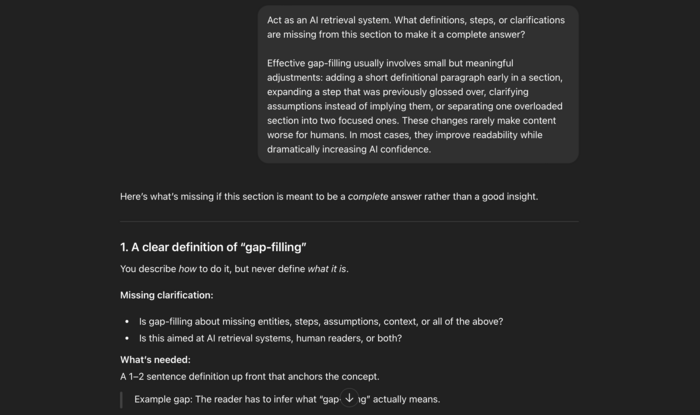
This keeps the process focused on strengthening logic and clarity rather than inflating word count. The goal isn’t expansion — it’s removing ambiguity so that both readers and AI systems can confidently understand and reuse the content.
For years, page titles and meta descriptions were treated as click-through levers. Write something catchy, test emojis, boost CTR, move on. In AI-mediated search, their role has quietly changed.
Titles and descriptions now act as semantic anchors. They help AI systems decide what a page is, not just whether it might be clicked.
When an AI model retrieves documents to answer a query, it needs fast, high-confidence signals about relevance and scope. Your title and meta description are often the first interpretive layer it sees.
AI systems are conservative by design. They avoid citing content when the topic or intent feels ambiguous. Clever, vague, or overly broad titles make it harder for models to determine whether a page is safe to use.
A title like:
“Everything You Need to Know About Modern SEO”
might attract human curiosity, but it tells an AI almost nothing.
Compare that with:
“AI Content Optimization: How to Get Cited in Google AI Overviews”
The second example establishes:
That precision reduces uncertainty — and uncertainty is the enemy of AI citation.
Meta descriptions are often ignored by SEOs because Google rewrites them frequently. AI systems, however, still use them as contextual hints, especially during retrieval and ranking of candidate sources.
A strong AI-friendly meta description does three things:
Think of it less as ad copy and more as a one-sentence abstract.
ChatGPT is particularly effective here — but only if you use it as a clarity filter, not a creativity engine.
Instead of asking: “Write a catchy title.”
Ask: “Is this title semantically clear enough for an AI retrieval system? What ambiguity or scope confusion does it contain?”
This shifts the goal from persuasion to precision.
You can also paste your draft title and meta description and prompt: “Rewrite this to maximize clarity and entity precision without increasing length.”
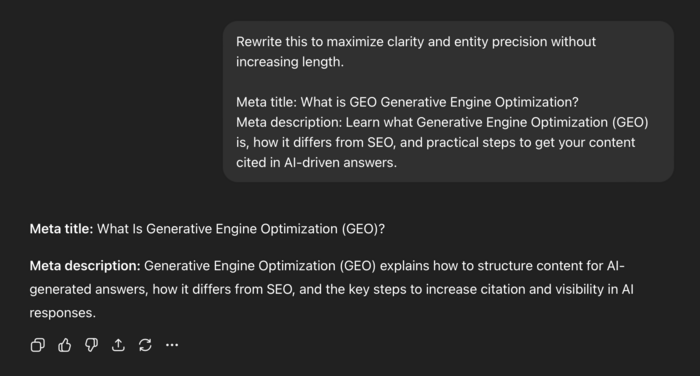
Or: “Does this title clearly signal topic, scope, and outcome? If not, how can it be made more explicit?”
For meta descriptions, a useful instruction is: “Rewrite this description as a one-sentence abstract that clearly defines topic, audience, and benefit.”
The key is constraint. Limit character count. Force specificity. Remove vague modifiers. Every word should reduce uncertainty, not decorate the page.
When titles and descriptions become explicit rather than clever, AI systems have an easier time categorizing, retrieving, and ultimately citing your content.
If there’s one type of content AI systems consistently gravitate toward, it’s information that looks hard to argue with.
Numbers. Measured outcomes. First-hand observations. Clearly attributed facts.
AI models are trained to reduce risk. When deciding what to cite, they prefer content that can be anchored to evidence, not interpretation. This is why two articles can explain the same concept equally well — but only one ever appears in AI Overviews.
The difference is often data.
When an AI system generates an answer, it’s implicitly making a claim on your behalf. The more defensible that claim appears, the safer it is to include.
Statistics and studies help in two ways:
This doesn’t mean every article needs original research. It means that content relying entirely on opinion, intuition, or generalized advice is harder for AI to trust.
Even a simple, well-sourced statistic can elevate an otherwise standard explanation into something citation-worthy.
Citable content isn’t just about adding numbers. It’s about presentation and context.
AI systems respond well when:
For example, instead of referencing “recent studies,” name the finding and explain why it matters. That explicitness reduces the AI’s need to infer, and inference is where models become cautious.
One of the biggest opportunities for SMBs and niche publishers is original observation.
You don’t need a massive dataset. AI systems value:
Even modest original insights are powerful because they are unique. AI models can’t find them elsewhere, which increases the likelihood of reuse and citation.
This is also where many large competitors fall short. They summarize widely available research, while smaller teams can contribute fresh perspective grounded in experience.
The key is restraint. Data should support the narrative, not replace it.
Introduce the idea first, then anchor it with evidence. Explain what the data confirms or challenges. This keeps content readable for humans while still giving AI systems something solid to latch onto.
Once your content becomes known — implicitly — as a source of concrete, verifiable information, something interesting happens. AI systems start pulling from it more frequently, even for related queries.
This is reputation building at the model level. It’s slow, but it compounds.
Over time, your site shifts from “one of many explanations” to “a reliable reference.”
AI systems have a bias that rarely gets discussed openly: they prefer information that feels recently validated.
That doesn’t mean new content always wins. It means content that has been recently reaffirmed is safer to use.
From an AI perspective, an article updated last month is a lower-risk citation than one that hasn’t changed in three years — even if the older article once performed extremely well.
When AI systems retrieve information, they’re optimizing for accuracy at the moment the question is asked. Outdated examples, deprecated features, or stale references introduce uncertainty.
If two pages explain the same concept equally well, the one that signals ongoing relevance usually wins.
This is why many “evergreen” articles quietly fade from AI visibility. They aren’t wrong — they just don’t look recently confirmed.
Refreshing content doesn’t mean rewriting from scratch. In most cases, it means revalidating the truth of what’s already there.
That might involve:
Even small updates, when done consistently, send a powerful signal: this content is alive.
AI systems notice those signals through changes in structure, wording, and contextual relevance.
Repurposing is often framed as a marketing tactic. In AI optimization, it’s also a reinforcement mechanism.
When the same core ideas appear across:
AI systems encounter your entities and explanations repeatedly, in slightly different formats. This repetition, when consistent, strengthens memory and confidence.
The key is alignment. Repurposed content should reinforce the same terminology, framing, and conclusions — not introduce conflicting interpretations.
Large publishers move slowly. SMBs and focused content teams can update and adapt much faster.
That agility is an advantage in AI search. Being able to revisit high-performing content quarterly — rather than annually — helps you stay aligned with how questions are being asked and answered right now.
Over time, this cadence builds a subtle edge: your content doesn’t just rank, it keeps getting reused.
When content is regularly refreshed and echoed across formats, AI systems begin to treat it as stable knowledge rather than a one-off answer.
That’s when visibility stops feeling fragile. Instead of chasing every update, you’re reinforcing a core set of ideas that keep surfacing across AI-driven experiences.
One of the most dangerous assumptions in 2026 SEO is that rankings still tell the full story.
They don’t.
AI-driven discovery has broken the direct relationship between position and visibility. You can rank first for a query and never be seen, while another site gets cited prominently inside an AI Overview and captures the user’s trust — without receiving a click.
That’s why tracking AI visibility has become its own discipline.
Traditional rank tracking assumes a linear path: search → results → click. AI search replaces that with a layered experience where answers appear before results, and citations often matter more than links.
In Google AI Overviews and AI Mode, users may:
From an analytics standpoint, this creates blind spots. Influence increases, but traffic doesn’t always reflect it. If you only track rankings and sessions, you miss whether your content is actually shaping decisions.
In other words, visibility has moved upstream.
AI visibility is about presence, not position.
It includes:
This is closer to brand visibility than classic SEO performance, but it’s driven by content structure, authority, and trust — not paid reach.
To measure it, you need tools that understand how AI results behave, not just where a URL ranks.
Turning on AIO tracking in Rank Tracker is quick and takes just a couple of clicks.
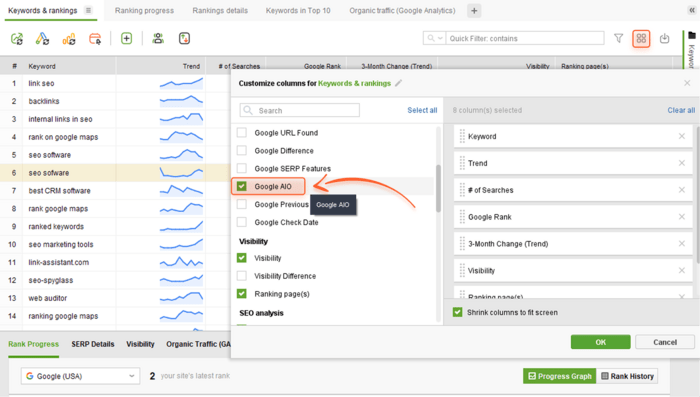
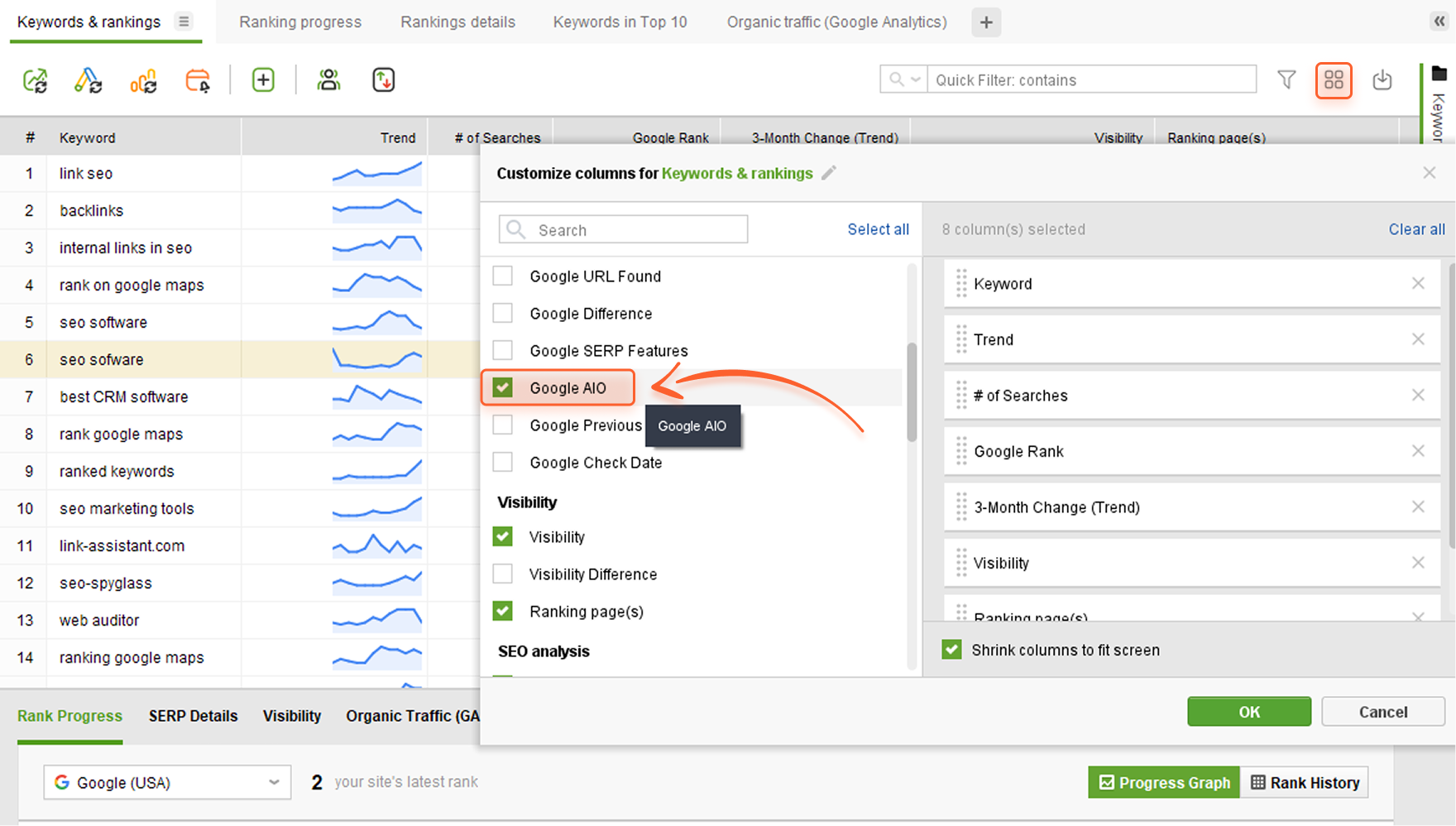
AIO Mentions and AIO Rank icons appear whenever a keyword triggers Google’s AI Overview.
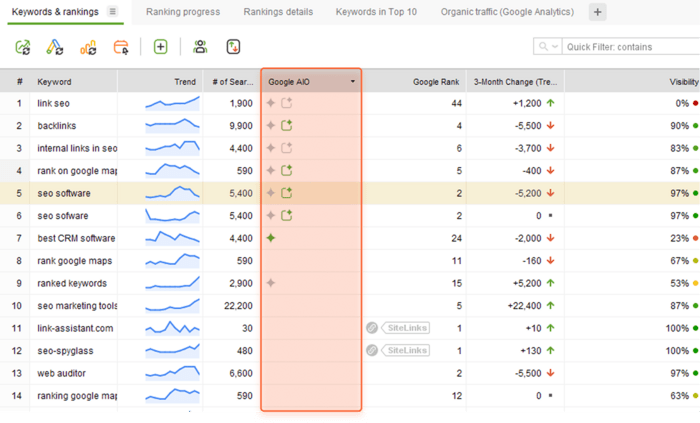
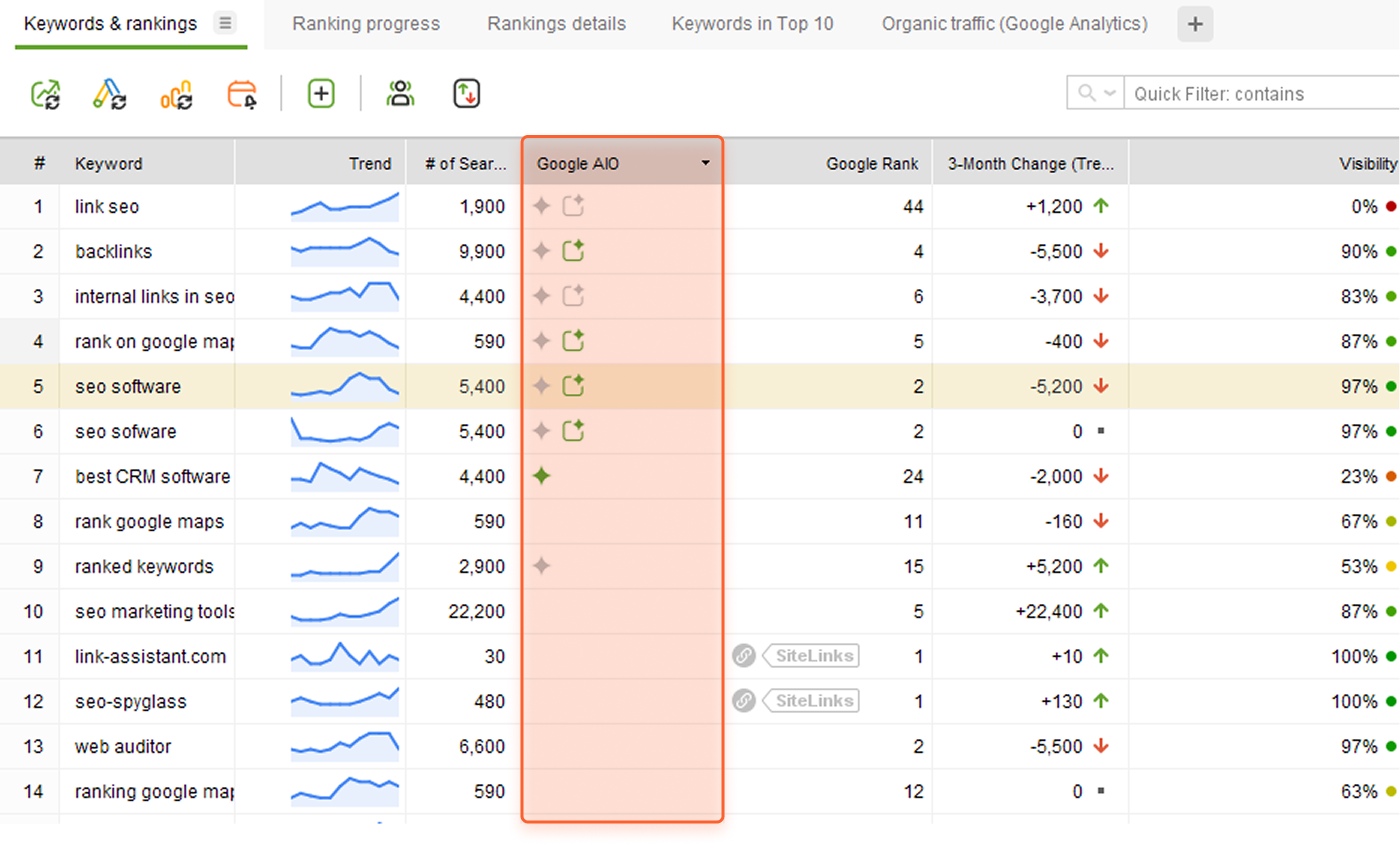
If your website is included in those results, the icons will light up in green. If your site isn’t there, the icons will remain grey.
Here’s a quick video tutorial on how to use the new Google AIO Tracking feature in SEO PowerSuite.
In AI-first search, success doesn’t always show up as traffic spikes. It shows up as consistent presence in answers.
Rank tracking still matters. But AI visibility tracking tells you whether your content is becoming part of the knowledge layer AI systems draw from — which is where long-term influence now lives.
AI didn’t kill SEO — it changed the surface area where SEO happens.
In 2026, visibility is no longer limited to rankings and clicks. It lives inside AI Overviews, generated answers, citations, and the quiet “verify” moments that shape decisions before users ever reach a website. Content that isn’t designed for this reality doesn’t just underperform, it becomes invisible.
For SMBs, this shift is an opportunity. AI systems reward focus, expertise, and consistency — not just brand size. For SEO professionals, it requires expanding beyond rankings into visibility measurement and entity strategy. For content marketers, it means writing less like publishers and more like reliable references.
Perhaps the most important takeaway is this: AI systems don’t just surface content — they remember sources. When your content repeatedly proves useful, accurate, and current, it becomes part of the answer layer itself.
The teams that win in the next phase of search won’t chase every algorithm change. They’ll build content ecosystems that are easy to trust, easy to extract from, and easy to return to.
Start there. The visibility will follow.



.jpg)
