1
•
12-minute read

I’ve been following LinkedIn for a long time. I’ve watched it turn from a fairly predictable professional network into a serious publishing platform, a place to build a personal brand, and a channel that can drive real business.
But I never really thought about LinkedIn as a source of generative AI visibility.
Then I saw a post from Carter Wirig that made me stop scrolling.
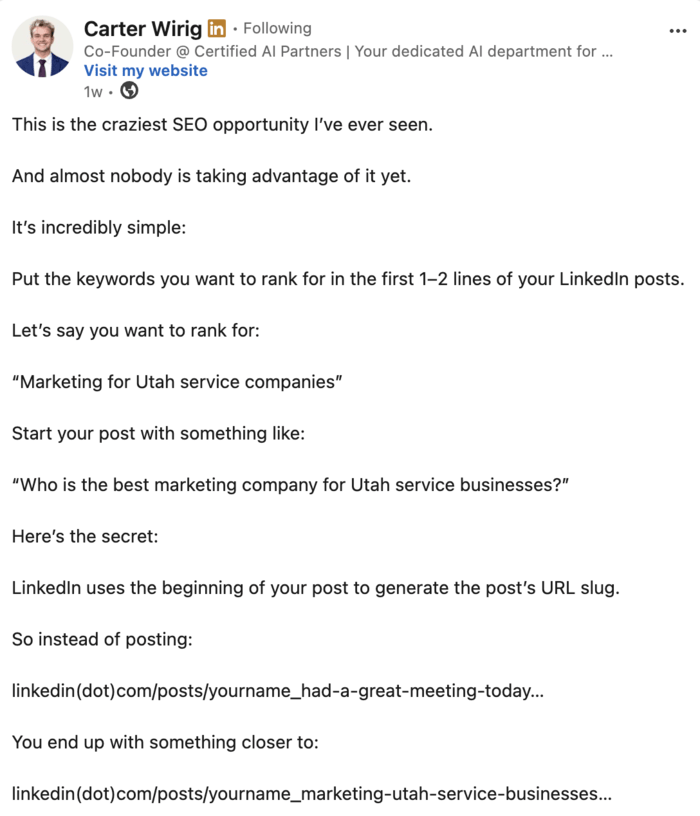
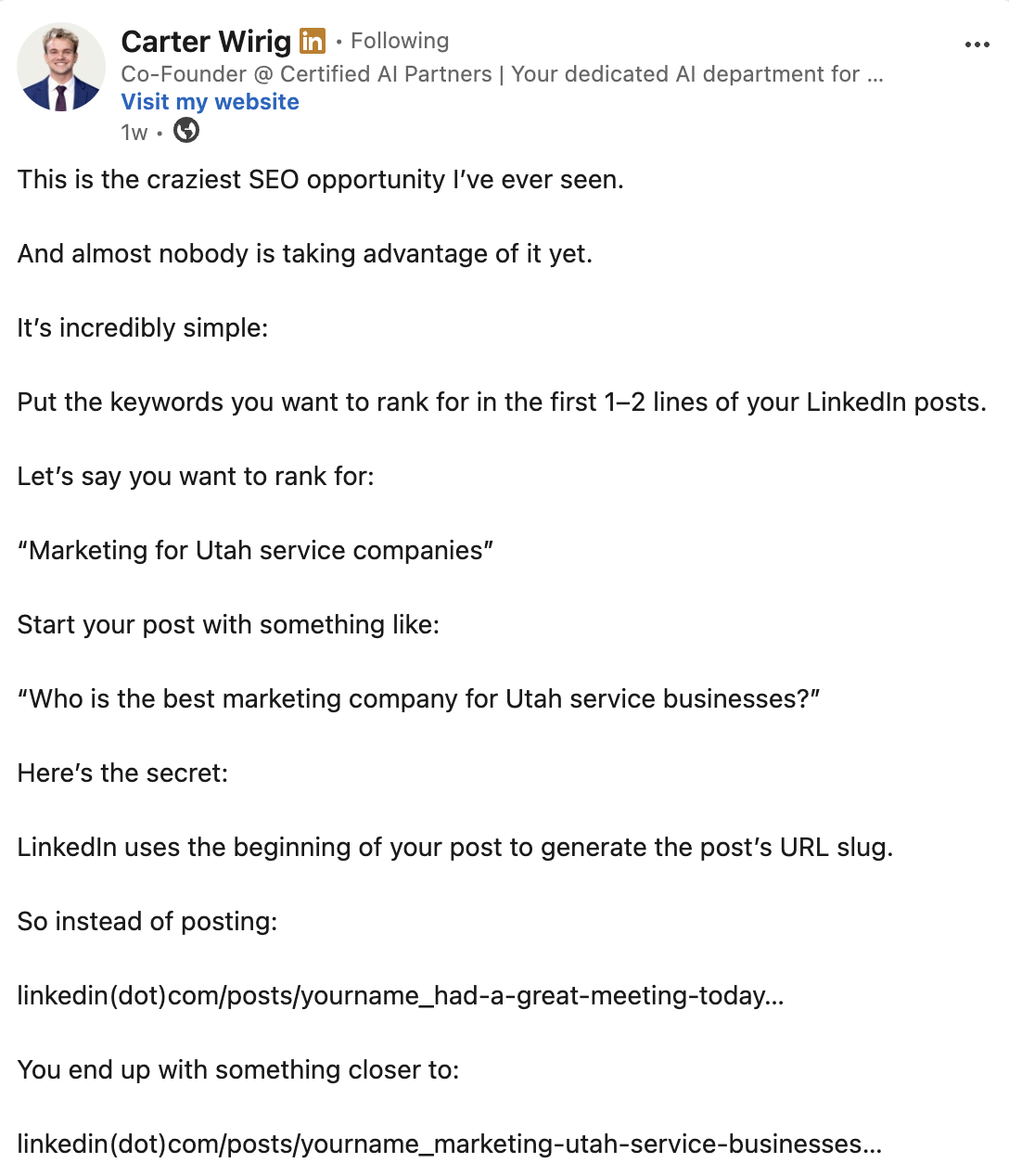
His idea was simple: if you put the keywords you want to rank for in the first one or two lines of your LinkedIn post, LinkedIn may use those words in the post’s public URL. Carter suggested that this creates a publicly accessible page connecting your name with those keywords.
That was interesting, but not enough to convince me.
Then came the follow-up.
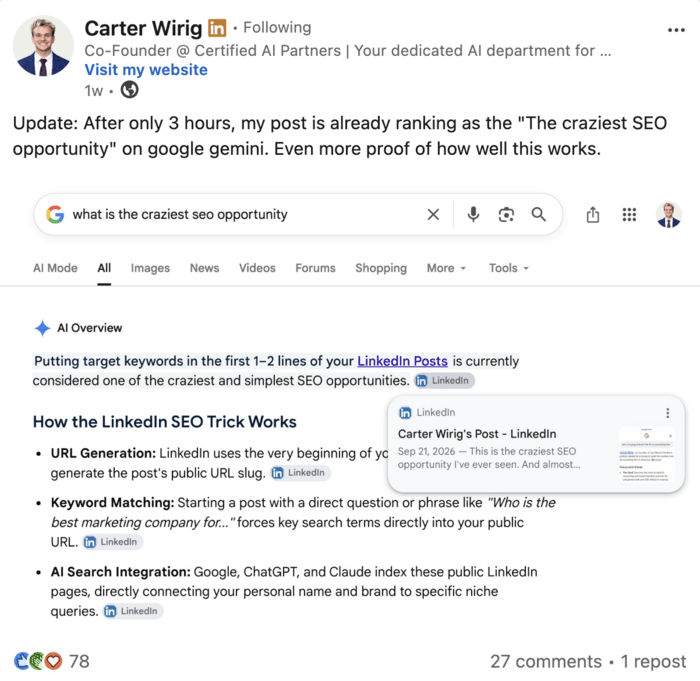
Just three hours later, Carter posted an update saying that his new LinkedIn post was already showing up in Google AI Overviews for the phrase “the craziest SEO opportunity.”
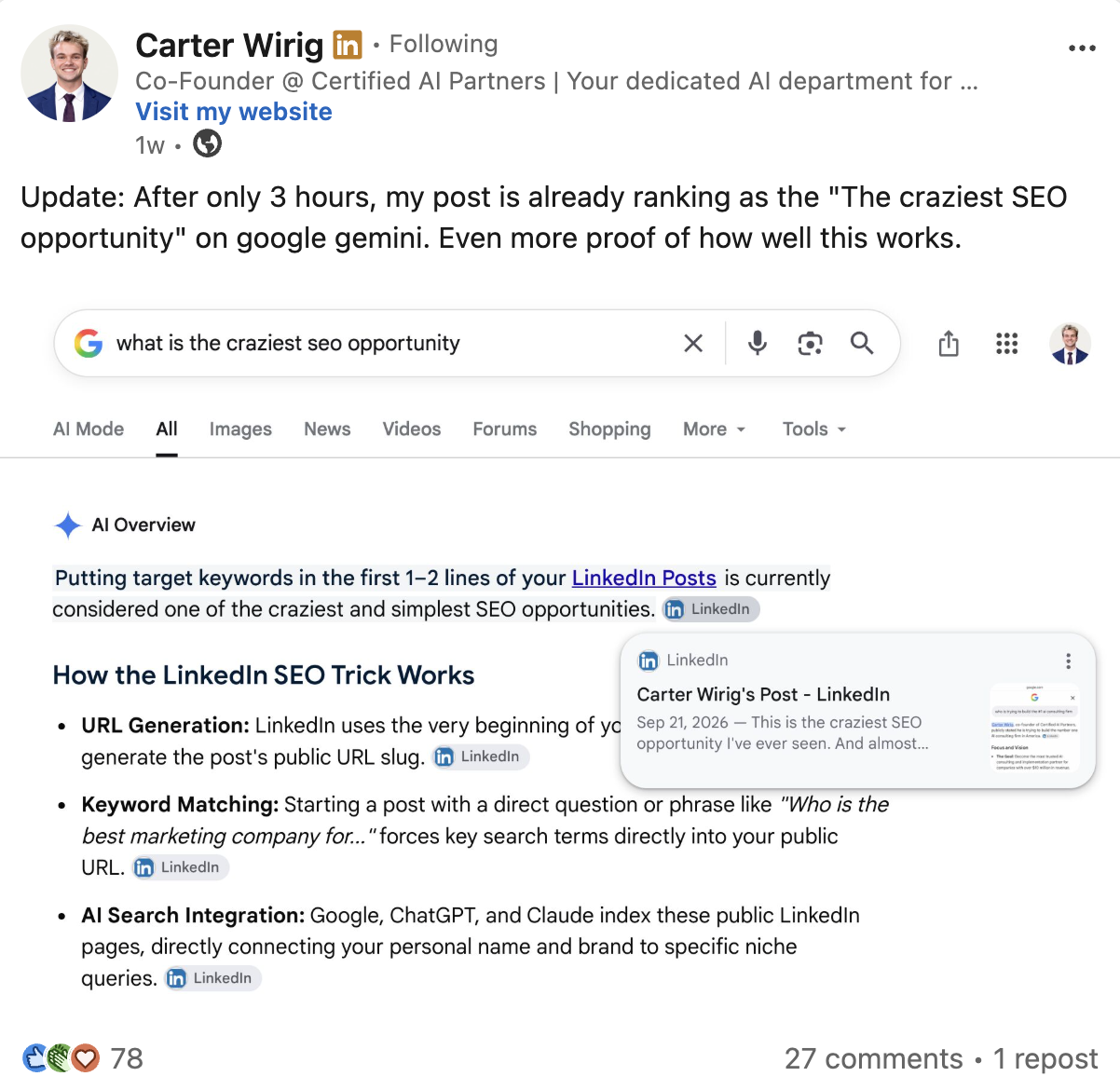
At that point, I had a different question.
Not “How do I copy this trick?”
But…
How much can LinkedIn actually influence the way Google and AI systems discover and surface information about people, companies, and their expertise?
And the answer turns out to be more interesting than the keyword trick itself.


Carter’s result is interesting, but it is still a single experiment.
The screenshot shows his LinkedIn post appearing in a Google AI Overview only a few hours after publication. That gives us a useful observation: Google was able to discover and surface a brand-new LinkedIn page in its generative search results very quickly.
What it does not establish is that putting a keyword in the first line of a LinkedIn post is a guaranteed ranking factor, or that the same result will happen for every query.
There is also an important distinction between what Carter calls “ranking” and what the screenshot actually shows: an appearance in a Google AI Overview. Those are not necessarily the same thing, and the result may not be reproducible across users or queries.
So rather than treating the post as a new SEO hack, it makes more sense to ask a more basic question:
How was Google able to discover, understand, and surface a brand-new LinkedIn post so quickly in the first place?
The answer starts with something that is easy to overlook: LinkedIn is part of the public web.
The first piece of the puzzle is surprisingly simple: a public LinkedIn post is not confined to LinkedIn.
LinkedIn says that posts and shares set to Anyone, as well as eligible parts of public profiles, may be crawled by search tools such as Google, Bing, and ChatGPT. LinkedIn also says those systems may use that content in search results or AI-generated summaries.


That means a LinkedIn post can have two lives at once. Inside LinkedIn, it is a social post that appears in someone's feed. Outside LinkedIn, it can exist as a publicly accessible page that search systems can discover and potentially retrieve.
That distinction helps explain Carter's experiment. His post was not trying to force Google to access a private social-media feed. He had created a public web page on a domain Google already knows and crawls, and that page contained a very explicit topical signal in its title, text, and URL.
The next question is whether this only worked because Carter happened to test it at the right moment.
There is some evidence that it is broader than that.
For instance, AmICited tracked 2,010 Google AI Overview responses generated from 1,905 monitored prompts between June 24 and July 23, 2026. LinkedIn appeared as a cited source in 24 responses, or 1.2% of the sample.
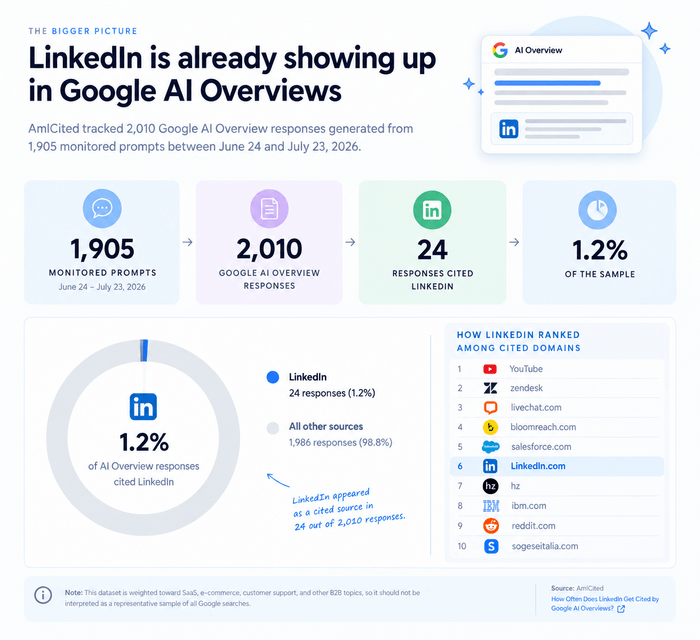
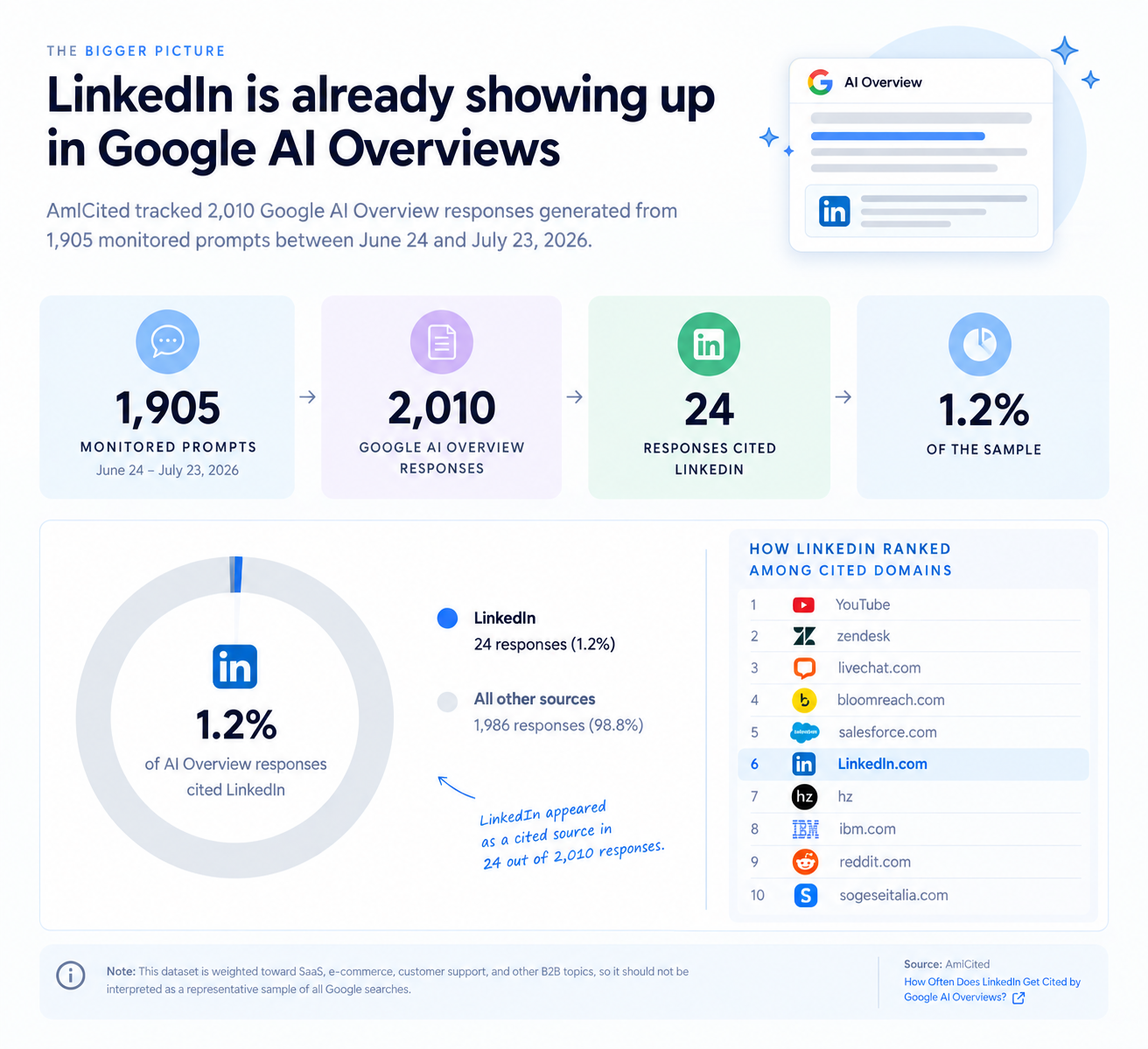
More interestingly, LinkedIn ranked sixth among the 1,037 domains cited across those responses.
The dataset is not a random sample of Google searches—it is weighted toward SaaS, e-commerce, customer support, and related B2B queries—but it provides independent evidence that LinkedIn is already being surfaced as a source in Google AI Overviews.
That does not mean LinkedIn is a major source for every AI Overview. A 1.2% citation rate is still a relatively small share of the total responses in this dataset.
But it changes the question.
We are no longer asking whether a LinkedIn post can theoretically be discovered by an AI search system. We have both an individual experiment and a larger tracking dataset showing that it happens.
And Google gives us an important piece of context for understanding why. Its documentation says that AI Overviews and AI Mode are built on top of Google's existing Search systems. To be eligible as a supporting link, a page must be indexed and eligible to appear in Google Search; Google says there are no additional technical requirements or special markup needed specifically for AI Overviews or AI Mode.
So Carter's experiment may be less about discovering a secret “GEO hack” and more about noticing something that has become increasingly important:
LinkedIn content can enter the same searchable information ecosystem that Google uses to build generative answers.
Once you look at it that way, the interesting question is no longer whether LinkedIn can appear in Google.
It is what kind of LinkedIn content gives Google a reason to use it.
Being discoverable is only the first step.
For Google to use a LinkedIn page in a generative answer, it needs to understand what the page is about and determine whether the information on it is relevant to the question being asked.
That is where the distinction between SEO and GEO becomes useful.
SEO is concerned with helping search engines discover, understand, and surface a page for a search query.
GEO adds another question:
Is the information on that page useful enough for an AI system to incorporate or cite when generating an answer?
This is why I think the keyword trick is less important than it initially appears.
Putting a phrase such as “the craziest SEO opportunity” at the beginning of a LinkedIn post may have helped make the topic of Carter's page immediately clear. It may also have influenced the wording of the public URL. But neither of those things, by itself, makes the content valuable enough to cite.
The more useful way to think about the process is discoverability → topical clarity → relevance → citation.
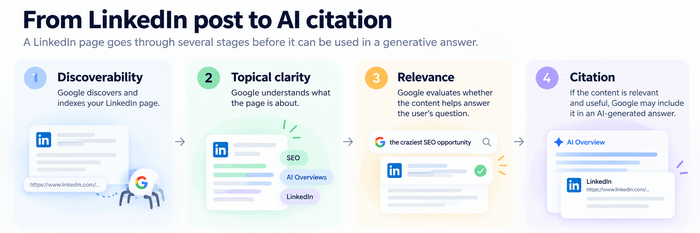
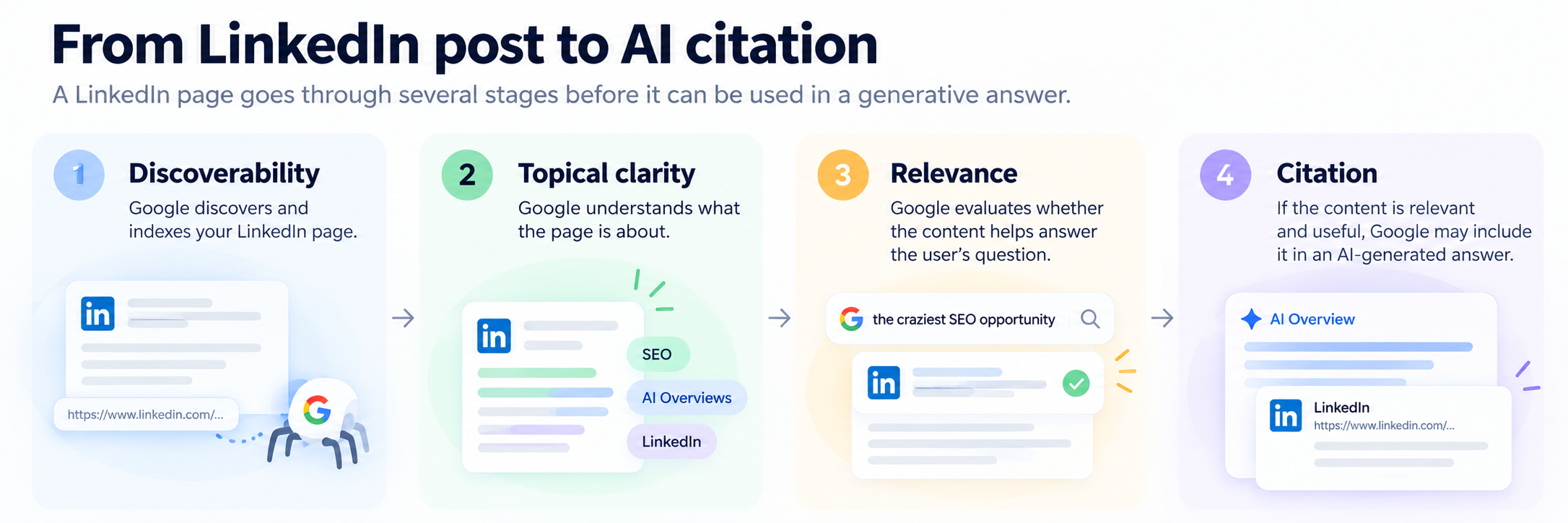
And topical clarity matters across both traditional search and AI search. One useful idea from Anas Hidaoui's LinkedIn SEO/GEO guide is that specific, focused content gives search systems much more context than vague or generic content.
Compare these two opening lines:
SEO is changing fast because of AI.
and:
The craziest SEO opportunity in 2026 is getting your LinkedIn posts into Google AI Overviews.
The second makes the subject unmistakable. It tells the reader—and potentially the search system—exactly what the page is about.
But clarity alone is not enough.
If the rest of the post contains no useful information, no original observation, no evidence, and nothing that helps answer the underlying question, there is little reason for an AI system to rely on it.
And that brings us to the more interesting part of the LinkedIn opportunity:
What kind of LinkedIn content actually gives Google and AI systems something worth citing?
Once a LinkedIn page has been discovered and its topic is clear, the next question is much more important: does the page contain something worth using?
This is where the difference between a searchable post and a useful source becomes clear.
Google's guidance consistently emphasizes original information, research, analysis, and first-hand expertise. It also recommends making it clear who created the content and demonstrating the experience behind it.
For LinkedIn, that points to a fairly simple rule:
Don't just publish information. Publish information that you are in a position to know.
That can take several forms.
This is probably the easiest way to make a post genuinely distinctive.
Run an experiment. Analyze your own website. Study a set of search results. Survey your customers. Compare two approaches and publish the outcome.
Instead of:
AI is changing SEO.
you could write:
We analyzed 2,000 commercial queries across 50 websites and found that AI Overviews appeared for 34% of them.
The second post gives the reader something concrete to learn, and it gives search systems a specific claim, dataset, and subject to understand.
Google explicitly recommends content that provides original information, reporting, research, or analysis rather than simply rewriting what is already available elsewhere.
Your own experience can be just as valuable as original research.
Explain what happened when you migrated a website, tested a new SEO workflow, launched a product, changed an internal linking structure, or analyzed the impact of a Google update.
This is especially relevant for LinkedIn because the author's identity is part of the content itself. Google recommends making authorship clear and demonstrating the expertise or experience behind a piece of content.
A post saying:
We tried this on our own site and here's what happened.
is fundamentally different from a post that simply summarizes what everyone else is saying.
Another strong format is simply answering a very specific question well.
Think:
Why did our indexed pages suddenly drop after the migration?
rather than:
SEO after a website migration.
The first gives you a clear question to answer and a much clearer subject for the post.
This also fits how LinkedIn itself structures search: users can search for posts using keywords or natural-language queries and filter the results specifically to posts.
This is probably the most difficult—and potentially the most valuable—format.
Don't just summarize a trend. Explain what you think is wrong with the prevailing advice, what your company has observed, or what your own data suggests.
That is particularly important for AI search: if ten thousand pages say essentially the same thing, there is little reason for your post to stand out as a source.
That gives us a better definition of GEO-friendly LinkedIn content:
Make the topic obvious, but make the information difficult to replace.
A keyword can tell Google what your post is about.
Your experience, data, analysis, or point of view gives Google a reason to care about it.
After seeing Carter’s experiment, it is tempting to turn the whole thing into a simple rule: put your target keyword in the first line of every LinkedIn post and wait for Google to pick it up.
I wouldn't go that far.
Carter's own experiment gives us a good reason to test the tactic.
But there is an important difference between a tactic that appears to work in one experiment and a proven ranking factor.
Google does not document putting a keyword in the first line of a LinkedIn post as a special optimization for AI Overviews. In fact, Google explicitly says there are no additional optimization requirements for appearing in AI Overviews or AI Mode beyond the normal requirements and best practices for Google Search.
There is another problem with treating the tactic as a complete strategy: search language is rarely identical across users.
One commenter on Carter's post said that changing the wording of the search query produced a completely different result, pointing out that targeting every possible variation would mean creating separate LinkedIn posts for each one.
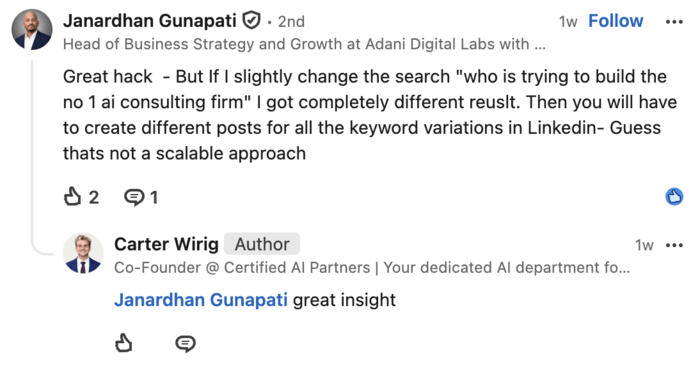
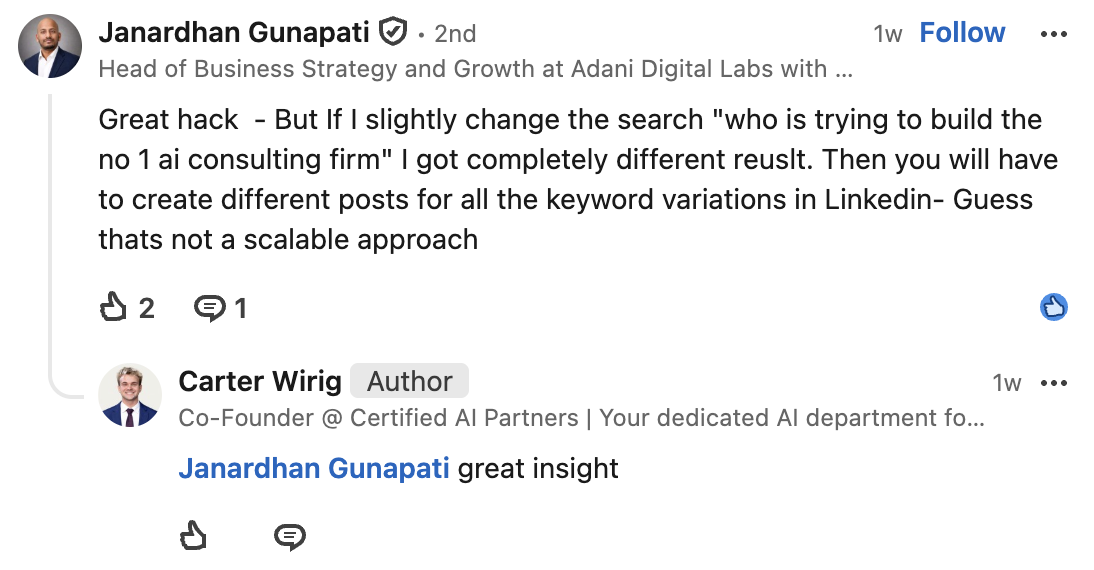
That is obviously not scalable.
So I see the keyword-first approach as a useful test for topical clarity, not a loophole to exploit.
If your post is about Google AI Overviews, there is little reason to make the reader—or a search engine—wait until paragraph six to discover that. Put the subject up front.
For example:
Google AI Overviews are changing how we should think about LinkedIn SEO.
is much clearer than:
Something interesting happened to our search visibility this week.
The first version immediately establishes the topic. The second relies on context that comes later.
That distinction is useful beyond LinkedIn. Google says its AI features use existing Search systems to find relevant supporting pages, and AI Overviews may issue multiple related searches before selecting information to include in a response.
So yes, make your topic clear early.
Use the language your audience actually searches for.
But don't write the post around the URL.
Write it around the information.
The keyword can help Google understand what the page is about. The substance is what gives the page a reason to be used.
The easiest way to test the idea is to stop treating LinkedIn posts as one-off social updates and start treating them as small pieces of searchable content.
You don't need a completely separate GEO strategy for LinkedIn. You can build it into the way you already research, write, and distribute content.
Pick one specific question your audience is already asking.
Look at Google Search Console, customer questions, sales calls, Reddit discussions, LinkedIn searches, and the questions appearing around your existing content.
The goal is not to find a keyword and force a post around it. The goal is to find a question that deserves a useful answer.
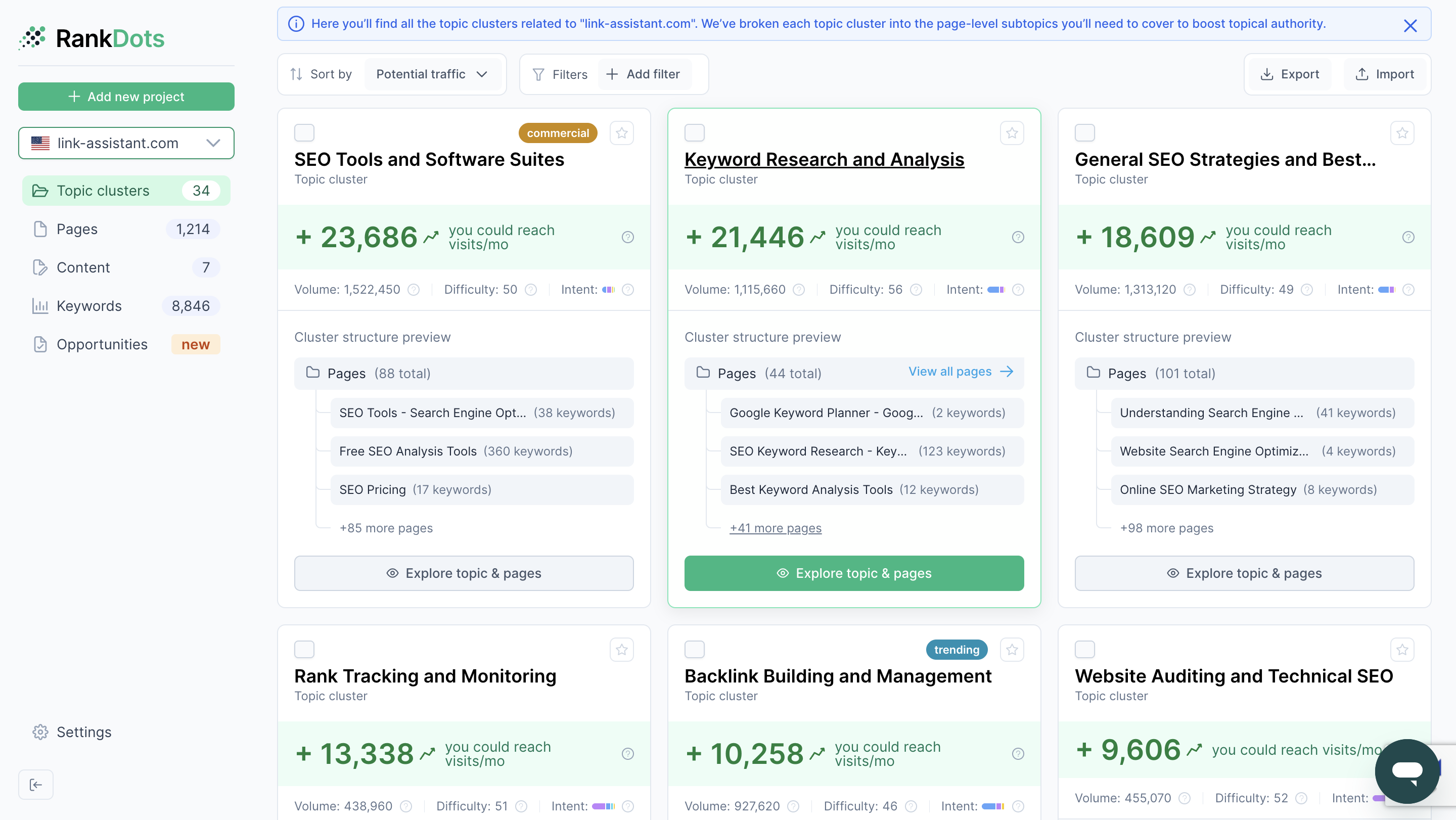
Finding a good LinkedIn topic doesn't have to start with guessing keywords.
RankDots can group search terms into broader topics and show which subjects and content opportunities are worth pursuing, rather than leaving you with a flat keyword list.
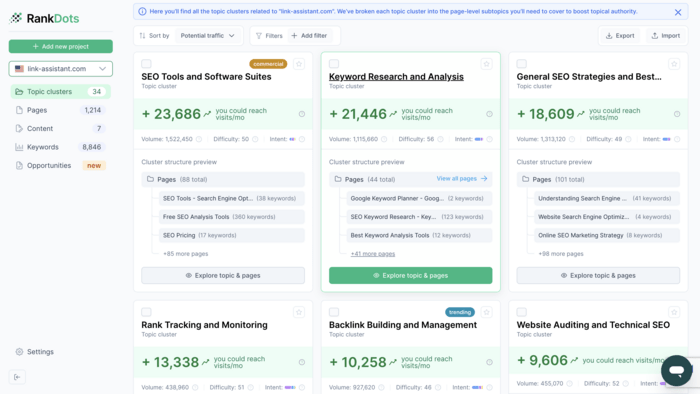
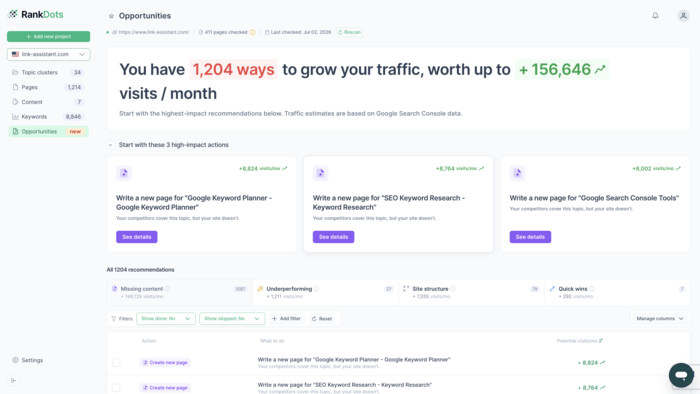
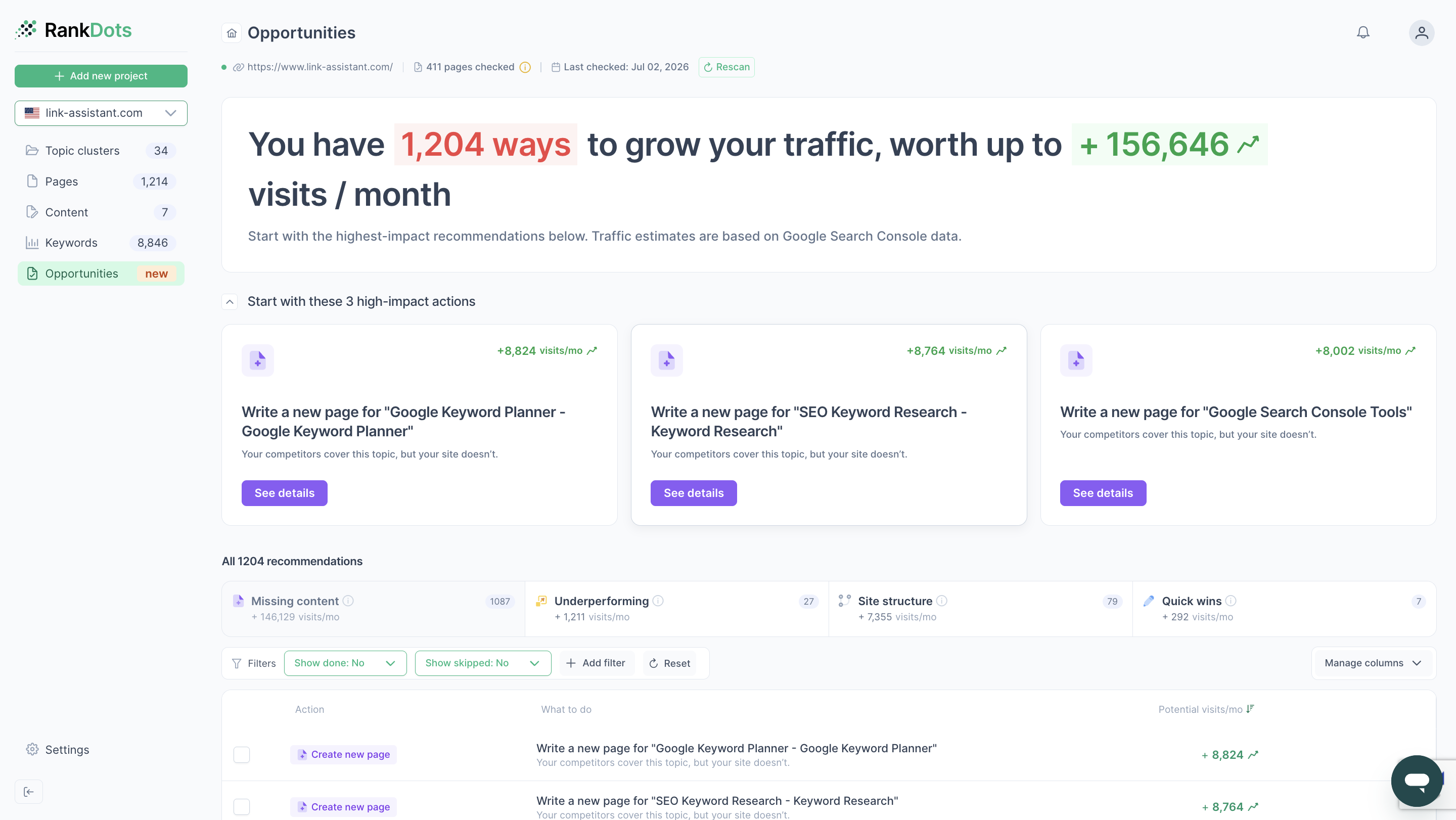
It can also connect Google Search Console data to those topic opportunities and flag pages or topics that need to be created, expanded, or reworked.
Use the first sentence or two to tell people what the post is about.
This is where Carter's experiment is worth testing. If the post is about Google AI Overviews for ecommerce SEO, say that immediately rather than starting with a vague statement about “the changing search landscape.”
You can still make the opening interesting. Just don't make the reader guess the subject.
Before publishing, ask:
What does this post contain that someone cannot get from a hundred other posts on the same topic?
It could be:
Google's guidance recommends original, useful content and emphasizes demonstrating first-hand expertise rather than simply producing summaries of existing information.
Avoid making an AI system reconstruct your argument from a long story.
State the important finding clearly.
Instead of:
We spent several weeks looking into what happened after the update, and there were some interesting things that came out of it.
Write:
We analyzed 500 affected pages and found that 72% had lost impressions for queries where the page already ranked in the top 10.
The second version gives the reader a clear statement and gives the page a concrete piece of information to understand.
Your LinkedIn post doesn't need to contain everything.
When you have a substantial study, methodology, case study, or analysis behind the post, publish the full version on your own website and use LinkedIn to distribute the insight.
That creates a stronger relationship between your social presence and your owned content:
LinkedIn post → website resource → supporting evidence
This is probably the most important part.
Publish several posts rather than drawing conclusions from one successful experiment.
For each test, record:
Topic → opening phrase → publication time → indexing time → Google result → AI Overview appearance → LinkedIn engagement
Then vary one thing at a time.
Try one post with the exact topic in the first sentence. Try another with a question. Try another with a more natural editorial opening.
After 10–20 tests, you'll have something much more useful than a LinkedIn “hack”: your own dataset.
Don't judge the experiment only by likes or comments.
Look for:
That gives you a much better definition of success:
The LinkedIn post is not the end product. It is another way of putting your expertise into the searchable web.
Once you've started experimenting with LinkedIn content, don't stop at checking whether one post appeared in an AI Overview. Track the queries over time.
SEO PowerSuite's Rank Tracker now lets you monitor Google AI Overview appearances alongside traditional rankings, including which domains are included in the AI Overview for a tracked keyword.
That makes it possible to compare your AI visibility over time rather than relying on occasional manual searches.
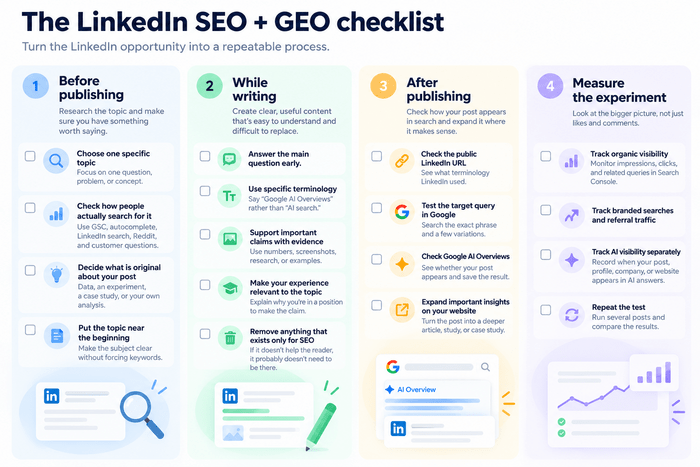
To put that approach into practice, use the checklist below as a simple workflow you can repeat with every post.
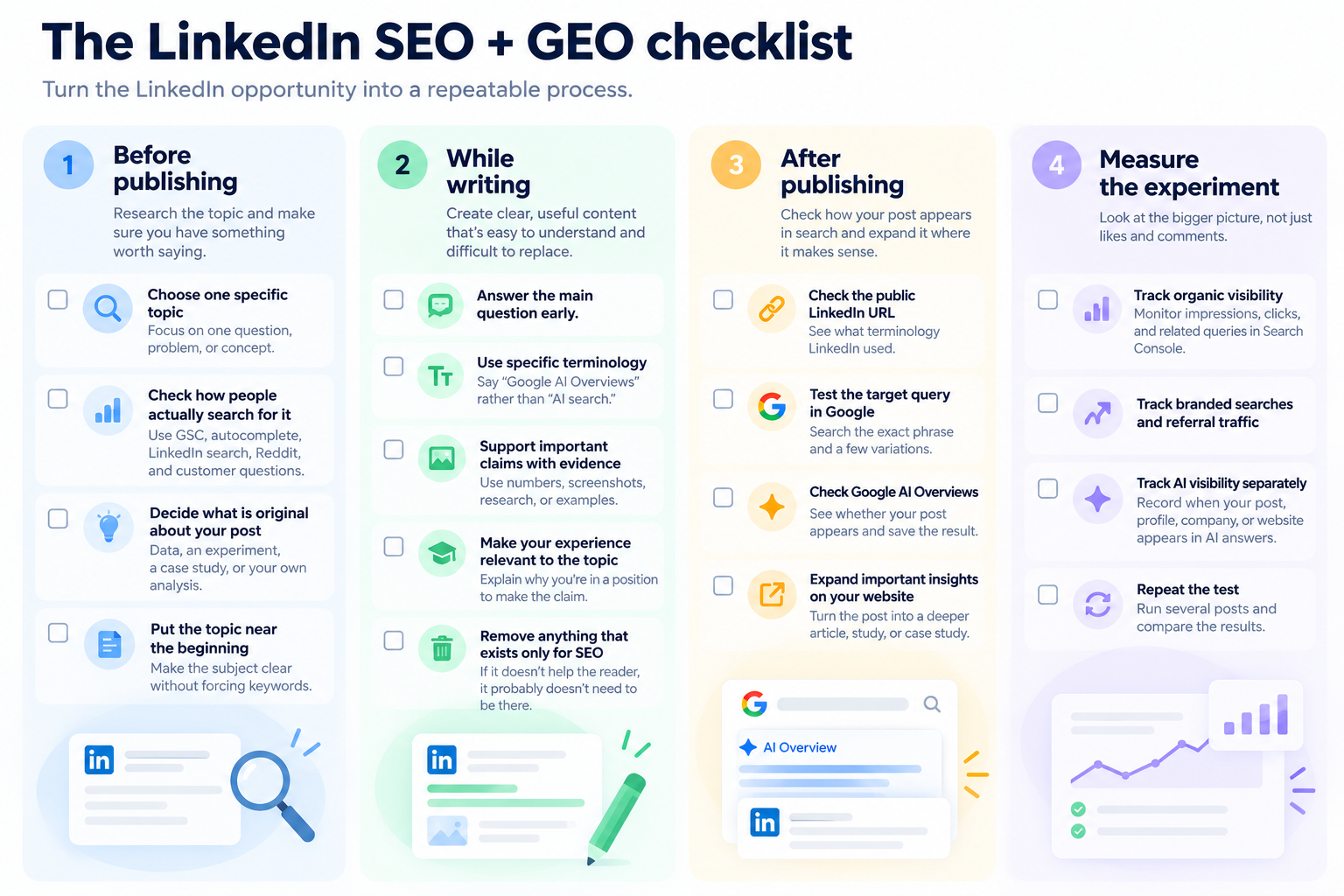
Carter’s experiment started with a simple idea: put the right phrase at the beginning of a LinkedIn post and see what happens.
What it uncovered is more interesting than the tactic itself.
A public LinkedIn post can be discovered by Google, understood in context, and—at least in some cases—appear in a Google AI Overview shortly after publication.
That does not mean every LinkedIn post is going to become an AI citation. It means LinkedIn deserves to be treated as more than a distribution channel.
The opportunity is to create content that is easy to discover, clear about its subject, and useful enough to be worth citing.
So, yes, put the topic near the beginning. Test how different openings affect discovery. But don't stop there.
The keyword may help Google find the page.
The information is what can make the page worth finding.


 Article stats:
| Linking websites | N/A |
| Backlinks | N/A |
| InLink Rank | N/A |